
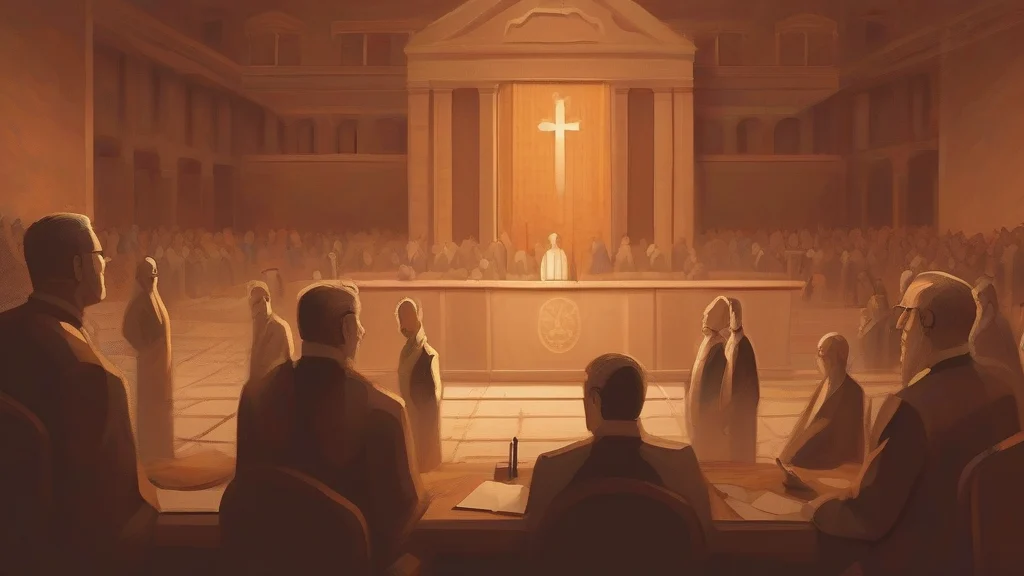
What does hierocracy mean?
Hierocracy is a rare formal term for rule by a hierarchy, especially one whose members are religious leaders and whose authority is understood as sacred. It describes a system in which ecclesiastical rank determines power, often combining spiritual and political authority. The word is chiefly associated with historical, religious, and theological discussion rather than contemporary everyday speech. Although hierocracy resembles both hierarchy and theocracy in meaning, it is more specific than either: hierarchy can describe any ranked organization, while theocracy usually emphasizes government based on divine authority or religious doctrine. Hierocracy specifically highlights rule by an ordered sacred class. Modern speakers will generally find hierarchy, clerical rule, or theocracy more natural, but hierocracy can be useful when the emphasis is on both religious status and hierarchical control.
nounA system of government or authority in which a ranked body, especially one composed of religious leaders, holds power.
- Government or authority exercised by a hierarchy, especially of religious leaders.
- A system organized as a sacred hierarchy, with power held according to ecclesiastical rank.
"The essay examines how hierocracy preserved both spiritual authority and political order."
"The council debated whether the ancient kingdom had developed into a form of hierocracy."
"The manuscript describes a strict hierocracy in which religious officials controlled both spiritual and civil affairs."
The plural is regular but rare and is chiefly used when comparing different systems of sacred or ecclesiastical rule.
"The study compares hierocracies in several medieval societies."
The word combines Greek elements meaning “sacred” and “rule,” forming a compact label for authority claimed to be holy.
Reviewed by Deb Chak, Editor. AI-assisted content curated by RJS Tech Solutions LLP.
Etymology of hierocracy
Hierocracy was formed in English from the combining form hier-, derived from Greek hieros, meaning “sacred” or “holy,” and -cracy, derived from Greek kratos, meaning “power” or “rule.” Its structure closely parallels related English words such as democracy and autocracy, while hier- connects it with hierarchy, hierophant, and hieroglyphic.
Related word forms
How hierocracy is actually used
A rare, formal, and chiefly historical or theological term. It is not normally used for ordinary organizational structures, for which “hierarchy” is the usual word.
Easily confused with hierocracy
A hierarchy is any system of people or things arranged in ranked levels, whereas hierocracy specifically involves rule by a sacred or ecclesiastical hierarchy.
A theocracy derives governmental authority from divine rule or religious doctrine, while hierocracy more specifically emphasizes governance by a ranked body of religious leaders.