
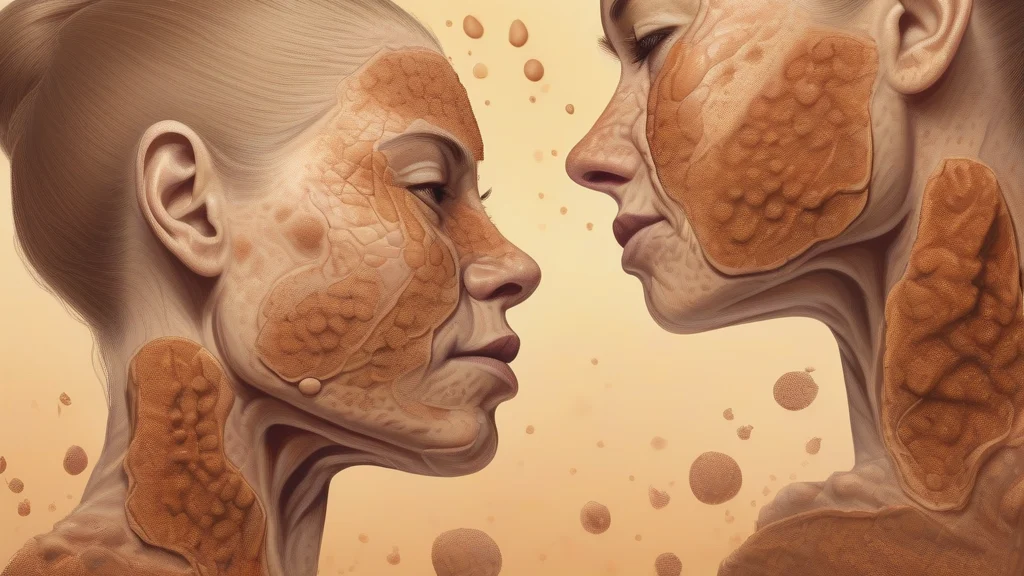
What does hyperkeratosis mean?
Hyperkeratosis is the excessive thickening of a tissue’s outer layer, especially the skin’s outermost keratin-rich layer. It commonly appears on the palms, soles, heels, and other areas exposed to repeated friction, pressure, dryness, or irritation, and may produce rough, hard, raised patches. The word is also used in pathology for abnormal keratin accumulation in other tissues or organs, depending on the affected site. In everyday dermatology, the term is more specific than keratosis: it emphasizes an excessive amount of surface thickening rather than a general accumulation of keratin. The condition can be protective when limited, as with a callus, but persistent or pronounced hyperkeratosis may crack, become painful, or indicate an underlying skin disorder. Diagnosis and treatment depend on the location and cause, with moisturizers, reduction of mechanical trauma, and treatment of associated irritation commonly involved.
nounAn abnormal thickening of the outermost layer of the skin, most often in the palms, soles, or areas exposed to chronic friction or irritation. The term may also describe excessive buildup of keratin in other tissues or organs.
- Excessive thickening of the outermost layer of the skin, often affecting the palms or soles.
- An abnormal accumulation of keratin in a tissue or organ, as in certain forms of epithelial change.
"Her dermatologist diagnosed palmoplantar hyperkeratosis and recommended regular moisturizing and careful reduction of the thickened skin."
"The biopsy showed hyperkeratosis without evidence of malignancy."
"Repeated pressure from the shoe caused hyperkeratosis along the heel."
Used when referring to multiple instances or sites of hyperkeratosis.
"The examination found hyperkeratoses on both heels."
A callus is nature's armor; hyperkeratosis is when that armor becomes excessive.
Reviewed by Deb Chak, Editor. AI-assisted content curated by RJS Tech Solutions LLP.
Where does hyperkeratosis come from?
The word combines the Greek prefix hyper-, meaning “over” or “excessive,” with keratosis, a term derived from Greek keras, meaning “horn,” and -osis, denoting a condition or process. The resulting word literally conveys an excessive keratinizing or horny change in tissue. It is closely related to keratin and keratoma, both of which belong to the same Greek root concerned with horn, horn-like tissue, and keratin.
Related word forms
How hyperkeratosis is actually used
This is primarily a medical and dermatological term. It is usually formal and diagnostic rather than conversational, and it should not be used as a synonym for an ordinary callus unless the thickening is unusually pronounced or clinically significant.
Easily confused with hyperkeratosis
Hyperkeratosis specifically means excessive thickening of the outer skin layer, whereas keratosis is a broader term for a buildup of keratin that may be normal or abnormal.