
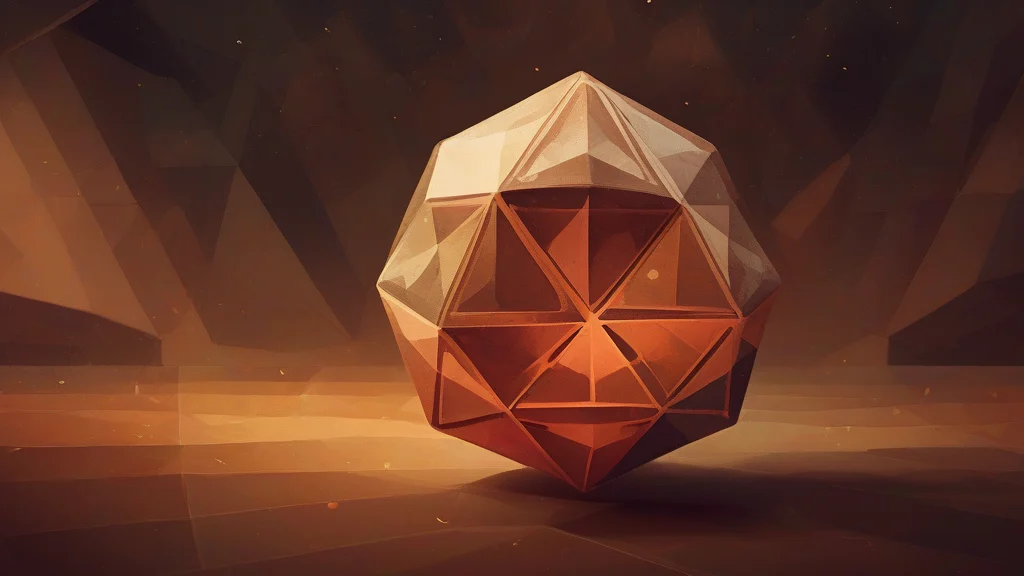
What does icosahedron mean?
An icosahedron is a polyhedron—a three-dimensional solid bounded by twenty triangular faces, thirty edges, and twelve vertices. Its best-known form, the regular icosahedron, has congruent equilateral triangular faces and is one of the five Platonic solids, distinguished by their identical regular faces. The term is mainly used in geometry, mathematical models, chemistry, and crystallography, where it can also refer to a physical model or an abstract framework. Despite its technical sound, the word is easy to interpret once its Greek elements are understood: eikosi means twenty, and hedron means face or base. In general conversation, however, “icosahedron” is sometimes used loosely for a twenty-sided gaming piece, although the familiar icosahedral die has triangular faces and the common twenty-sided die is a dodecahedron. The word is therefore useful not only as a precise geometric label but also as a reminder that everyday names and specialist classifications do not always match.
nounA polyhedron with 20 triangular faces, 30 edges, and 12 vertices. In its regular form, all its faces are congruent equilateral triangles, making it one of the five Platonic solids.
- A polyhedron having 20 triangular faces, 30 edges, and 12 vertices, especially the regular form whose faces are congruent equilateral triangles.
"The model maker constructed the star from the vertices of a regular icosahedron."
"Crystals of a certain kind can be described using an icosahedron as a model of their atomic arrangement."
"The architect's design was based on the geometry of a regular icosahedron."
The conventional mathematical plural is icosahedra. The form icosahedrons is also accepted, but icosahedra is more usual in formal geometry.
"Several interlocking icosahedra formed the framework of the model."
The familiar twenty-sided die is a dodecahedron, not an icosahedron: its faces are pentagons, not triangles.
Reviewed by Deb Chak, Editor. AI-assisted content curated by RJS Tech Solutions LLP.
Where does icosahedron come from?
The English name is a Latinized Greek compound formed from eikosi, meaning “twenty,” and hedron, meaning “seat,” “base,” or “face.” It belongs to a family of scientific terms ending in -hedron that describe polyhedra according to the number of their faces. Its English development occurred within the early modern tradition of adapting Greek geometric terminology into Latinized learned nomenclature.
Related word forms
How icosahedron is actually used
This is primarily a specialist term in geometry and related scientific fields. The conventional mathematical plural is icosahedra, although icosahedrons is also accepted.
Easily confused with icosahedron
An icosahedron has 20 triangular faces, whereas a dodecahedron has 12 pentagonal faces and is the usual shape of a twenty-sided die.
An icosahedron has 20 faces and 12 vertices, while a tetrahedron has only four triangular faces and four vertices.