
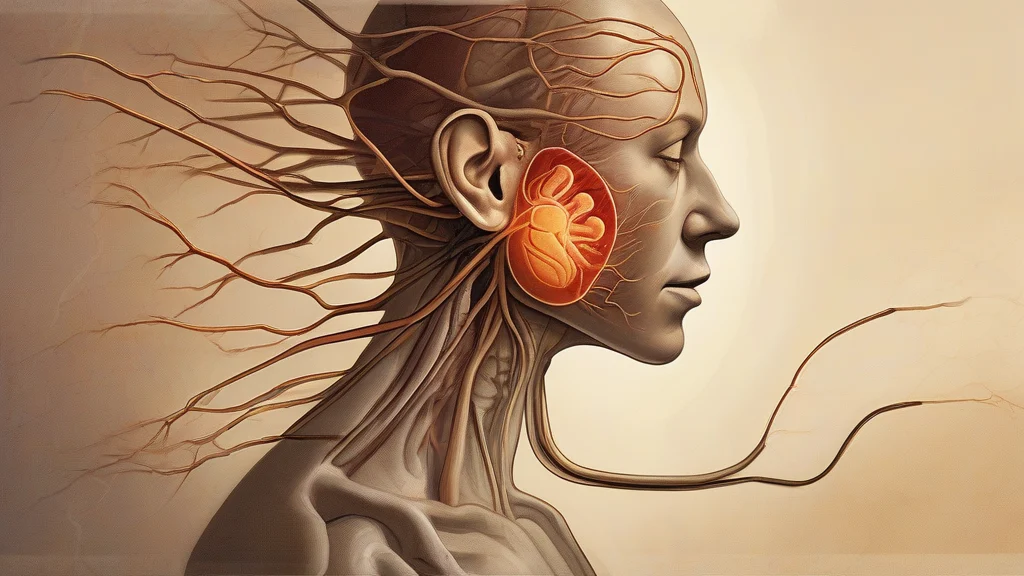
What does innervation mean?
Innervation is the connection of nerves to an organ, muscle, or other body part, either as a supply of nerves or as the neural stimulation produced through them. In anatomy, it describes how a particular structure is wired: for example, sympathetic and parasympathetic innervation influence different aspects of the heart's activity. The term can also refer to nerve stimulation itself, especially in physiological and medical discussions. Its technical character makes innervation especially useful in contexts involving the nervous system, muscular control, and the function of organs. Although the word may sound unfamiliar in everyday conversation, it names a basic concept in biology: the patterned relationship between the nervous system and the tissues it controls.
nounThe supply or distribution of nerves to a particular organ or body part. In a medical or physiological context, it can also refer to the stimulation of an organ or tissue through its nerves.
- The supply or distribution of nerves to an organ, muscle, or body part.
- The physiological stimulation of an organ or tissue through its nerves.
- The arrangement or pattern of nerves within a structure.
"The autonomic nervous system provides sympathetic innervation to the heart and digestive system."
"Researchers examined the innervation of the bladder in patients after surgery."
"Exercise may alter the muscular innervation involved in coordinated movement."
Plural is uncommon in general use but can refer to multiple distinct arrangements or supplies of nerves.
"The study compared the innervations of several small muscles."
Innervation is the body's wiring plan: each organ has its own pattern of nerves, and changing that wiring can change how the organ functions.
Reviewed by Deb Chak, Editor. AI-assisted content curated by RJS Tech Solutions LLP.
Where does innervation come from?
Innervation derives from the Latin verb innervare, meaning 'to furnish with nerves' or 'to supply with nerves.' The word entered English in the early 19th century in medical and physiological usage. It is related to innervate, nervate, nervous, and nerve, all of which reflect the Latin root nervus, meaning 'sinew' or 'nerve.'
Related word forms
How innervation is actually used
Primarily a technical term in anatomy, medicine, neuroscience, and physiology. It is less common in general speech, where nerve supply may be more accessible.