
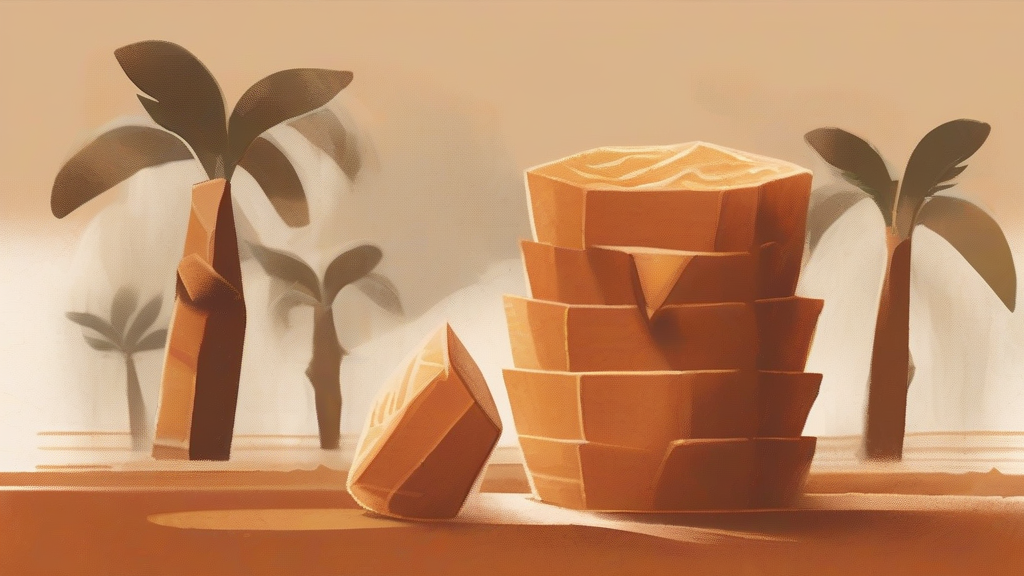
What does jaggery mean?
Jaggery is a traditional, unrefined sugar most closely associated with South Asia. It is made by boiling down the sap of palm trees until the sugars concentrate and darken, producing a brown, slightly moist substance with a pronounced caramel-like flavor. In India, Bangladesh, Sri Lanka, Nepal, and neighboring regions, jaggery is commonly used in sweets, drinks, sauces, and breads, and may be sold in blocks, lumps, granules, or syrup form. Unlike ordinary granulated white sugar, jaggery retains more of the original sap’s color, aroma, and mineral content. The name also occurs in parts of the Caribbean for related palm sugars. Although increasingly replaced by packaged brown or white sugar in many households, jaggery remains important in South Asian cooking and is valued for its distinctive flavor. The word is neutral and familiar rather than archaic or highly specialized.
nounAn unrefined, dark brown sugar made traditionally from the sap of palm trees. It has a strong caramel-like flavor and may be sold as blocks, lumps, or syrup.
- Coarse, unrefined brown sugar traditionally produced by evaporating the sap of palm trees.
"She added a piece of jaggery to the tea to sweeten it."
"The cook dissolved a lump of jaggery in a pan of simmering milk."
"Jaggery is often used to sweeten South Asian breads, sauces, and drinks."
Jaggery is normally an uncountable mass noun, so a plural is uncommon and generally appears only when individual blocks or lumps are counted.
"The market sells jaggery in small jaggerys."
Before refined sugar became widely affordable, jaggery was the traditional sweetener tapped directly from palm trees.
Reviewed by Deb Chak, Editor. AI-assisted content curated by RJS Tech Solutions LLP.
Etymology of jaggery
English borrowed jaggery from the Portuguese jagra, a term associated with palm sugar and the Indian Ocean trading system. The Portuguese word ultimately came from a South Asian language, although its precise source and transmission route are disputed. Its use in English reflects the longstanding commercial and cultural connections between Europe and South Asia.
How jaggery is actually used
The word is especially common in South Asian English. In India and neighboring countries it often refers specifically to palm-derived sugar, although the term can also denote other traditional unrefined sugars. It is ordinarily used as an uncountable mass noun.
Easily confused with jaggery
Jagery is a less common spelling variant of the same substance, not a different kind of sugar.