
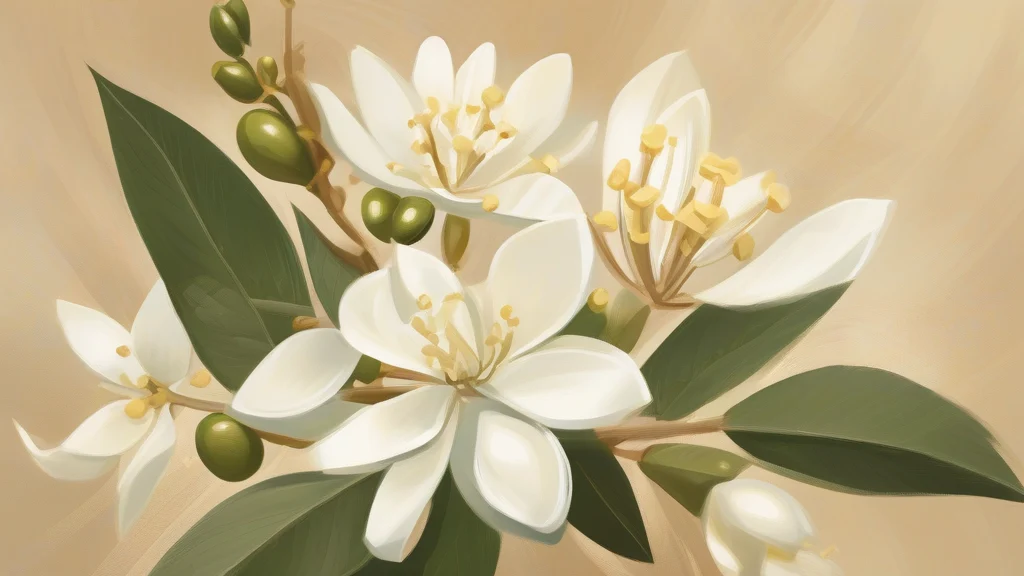
What does jasmine mean?
Jasmine names a family of fragrant flowering plants, especially varieties with delicate white blossoms that release a sweet, distinctive scent. The term can refer to the plant itself, to a fragrance or flavor derived from or evocative of the flowers, and, less commonly, to pale yellow or creamy white shades associated with jasmine blossoms. Jasmine is widely encountered in jasmine tea, perfumes, soaps, essential oils, and floral arrangements. In gardens, jasmine is valued both for its ornamental flowers and for the atmosphere created by their strong, pleasant aroma, which is often especially noticeable in the evening. Although other plants may also be called jasmine, the name most commonly refers to plants in the olive family, including the widely cultivated Arabian jasmine. The word has a long history in English, having travelled through Persian and Arabic before becoming a familiar name for both the flower and its scent.
nounA fragrant flowering plant of the olive family, cultivated for its sweetly scented white or pale yellow blossoms. The word can also refer to a fragrance, flavor, or tea made from or associated with these flowers.
- A fragrant flowering plant of the olive family, especially one of the cultivated species known for its white blossoms.
- A fragrance or flavor associated with jasmine flowers, as in jasmine perfume or jasmine tea.
- A pale yellow or creamy white color resembling some varieties of jasmine blossom.
"The garden filled with the sweet scent of jasmine on the warm summer evening."
"She brewed a pot of jasmine tea and set it beside the open window."
"The room was decorated with jasmine flowers and a small bottle of jasmine oil."
“Jasmines” is used when referring to individual plants or blossoms; “jasmine flowers” is often clearer when the blossoms, rather than the plants, are meant.
"The florist arranged several jasmines in a shallow glass bowl."
Jasmine is more than a pretty flower: its name is a borrowed journey from Persian and Arabic, and its perfume has flavored teas, soaps, and perfumes for centuries.
Reviewed by Deb Chak, Editor. AI-assisted content curated by RJS Tech Solutions LLP.
Where does jasmine come from?
The English word “jasmine” comes through Arabic and Persian forms ultimately associated with the Persian word yāsmīn. The Arabic form jasmin reflects that borrowing, and the word reached English through the vocabulary of trade and the transmission of names for plants and perfumes. Its modern sense developed around the fragrant flowering plant and later extended to scents and flavors associated with it.
How jasmine is actually used
The word is commonly used for both the plant and its characteristic fragrance. In culinary contexts, “jasmine” usually refers to jasmine tea or a jasmine-flavored product; the flowers themselves are not generally eaten as a standard ingredient. The color sense is less common and is often expressed as “jasmine green” or “jasmine white.”