
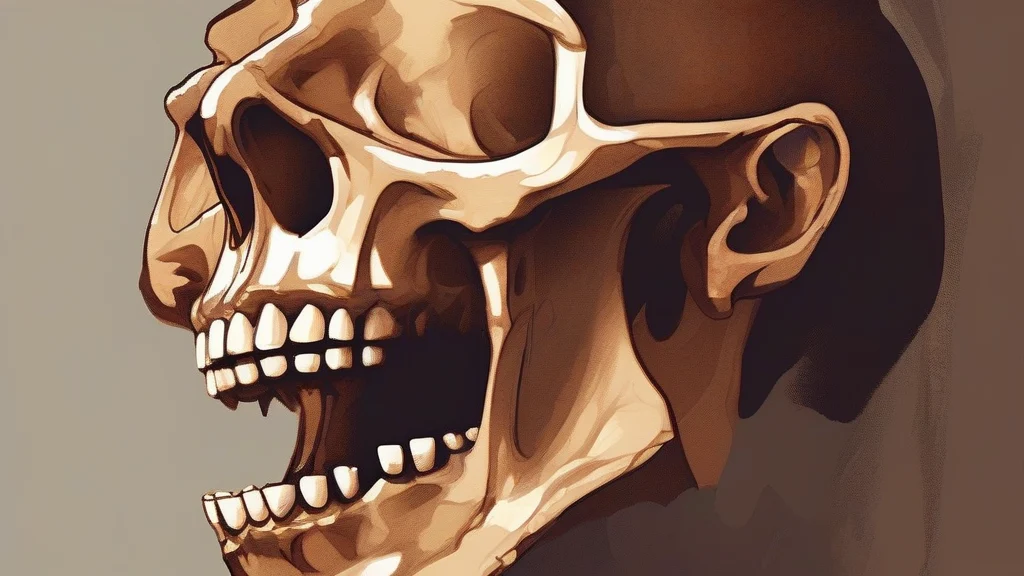
What does jaw mean?
A jaw is the lower part of the face, especially the firm bony structure that supports the lower teeth. The term is used in ordinary conversation, anatomy, dentistry, and mechanics, although its mechanical sense refers more specifically to a gripping component rather than to the face. When discussing both the upper and lower structures of the mouth, speakers often use the plural “jaws,” as in “his strong jaws.” In informal English, “jaw” can also mean talk or speech, particularly when it suggests that someone is talking too much or complaining loudly. Expressions such as “clench your jaw” and “drop your jaw” are common in descriptions of physical tension, determination, or surprise. The word is especially useful because it can describe both a familiar part of the human body and the similarly shaped gripping part of a machine.
The lower part of the face, forming the lower jaw and containing the lower teeth; by extension, the jawbone or the upper and lower jaws together. In machinery, one of a pair of gripping parts.
"She clenched her jaw and tried not to cry."
The plural “jaws” is common when referring to the upper and lower jaws together or to a powerful, prominent jaw structure.
To talk or speak at length, especially in a way that is idle, loud, or argumentative.
"They were jawing in the hallway long after the lesson had ended."
This sense is informal and is especially common in British, Irish, and Scottish English, though it is also understood in American English.
Use the plural when referring to the upper and lower jaws together, to a strong or prominent jaw structure, or to the gripping parts of a tool.
"The crocodile's powerful jaws closed around its prey."
The phrase “drop one's jaw” captures the universal reaction of being so surprised that your mouth falls open.
Reviewed by Deb Chak, Editor. AI-assisted content curated by RJS Tech Solutions LLP.
Where does jaw come from?
The word appeared in Middle English in the sense now associated with the lower part of the face. Its later English development was influenced by Old French forms meaning “jaw” or “cheek,” while the modern word is also related to “jowl.” The mechanical sense developed later by analogy with the gripping action of the human jaw.
Related word forms
How jaw is actually used
In medical and anatomical contexts, “jaw” is common and generally neutral, while “jawbone” is more precise. “Jaw” is also used informally for a person’s face or for prolonged talking, as in “don't jaw with me.”
Easily confused with jaw
A jaw is the lower part of the face and its bony structure, whereas a jowl is the fleshy fold of skin beneath the jaw or the lower cheek.
A jaw is the anatomical region or structure of the lower face, while a jawbone specifically refers to the bone forming the lower jaw.