
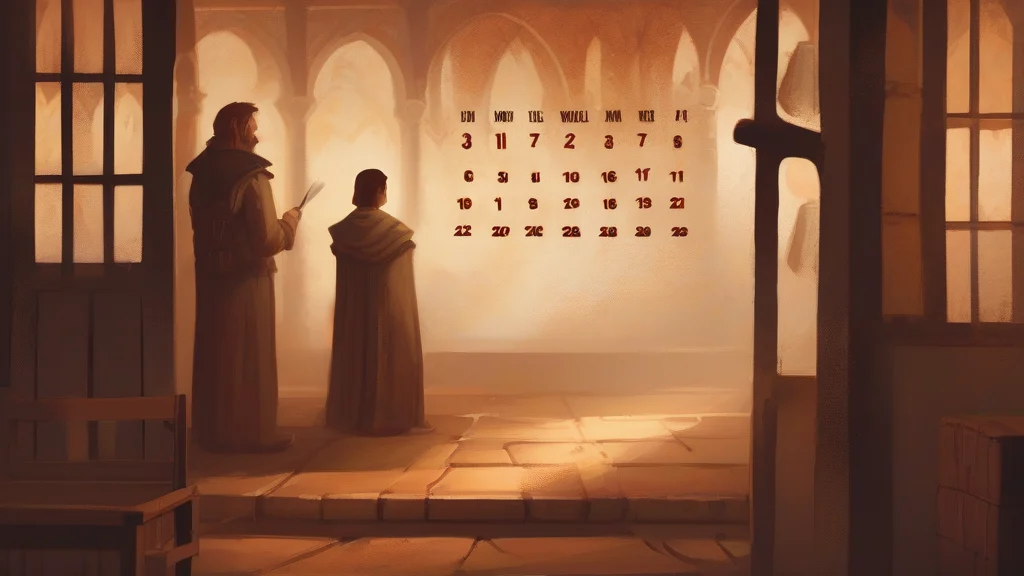
What does kalendar mean?
“Kalendar” is an archaic and literary variant of “calendar.” It denotes either a system used to measure time or a written arrangement of the days belonging to a particular period. In modern English, the word is uncommon, but it can lend a sense of antiquity, ceremony, or poetic tradition, especially when referring to Roman, medieval, or religious timekeeping. Its spelling with a “k” reflects older forms of English and preserves the influence of the Latin word kalendarium. Although ordinary speakers normally use “calendar,” “kalendar” remains suitable in historical narration, poetry, formal or archaic prose, and descriptions of traditional institutions. It can also imply a list of dates or observances, such as saints’ days, rather than merely the modern calendar as a household planning tool.
nounAn archaic and literary form of “calendar,” especially used in historical, poetic, or ceremonial contexts. It can refer to a system of reckoning time or to a list of days arranged by date.
- A system for reckoning and dividing time into days, months, and years.
- A written list or table showing the days of a month or year, often with additional information.
"The monastery recorded each saint's feast day in its ancient kalendar."
"The first page of the manuscript contained a kalendar marked with saints’ feast days."
"According to the old Roman kalendar, the new year began in March."
The regular plural is “kalendars,” though the singular form is now chiefly archaic or literary.
"Several ancient kalendars preserve details of the early Roman calendar."
Once the standard word in English, “kalendar” survives mainly in the atmosphere of old books, poetry, and ancient rites.
Reviewed by Deb Chak, Editor. AI-assisted content curated by RJS Tech Solutions LLP.
Etymology of kalendar
The English word comes through Old English calendarium from Latin kalendarium, a term associated with the kalendae, the first day of the month in the Roman calendar. The form “kalendar” reflects the spelling conventions of Middle English and remained in use for centuries. The modern spelling “calendar” became established as the standard form, while “kalendar” survives chiefly in archaic and literary language.
How kalendar is actually used
This word is archaic and literary rather than ordinary modern English. It may be chosen for historical flavor, solemnity, or stylistic effect, especially in poetry and descriptions of ancient customs.
Easily confused with kalendar
“Kalendar” is an archaic or literary variant of “calendar,” while “calendar” is the standard modern spelling and is used in ordinary contemporary English.