
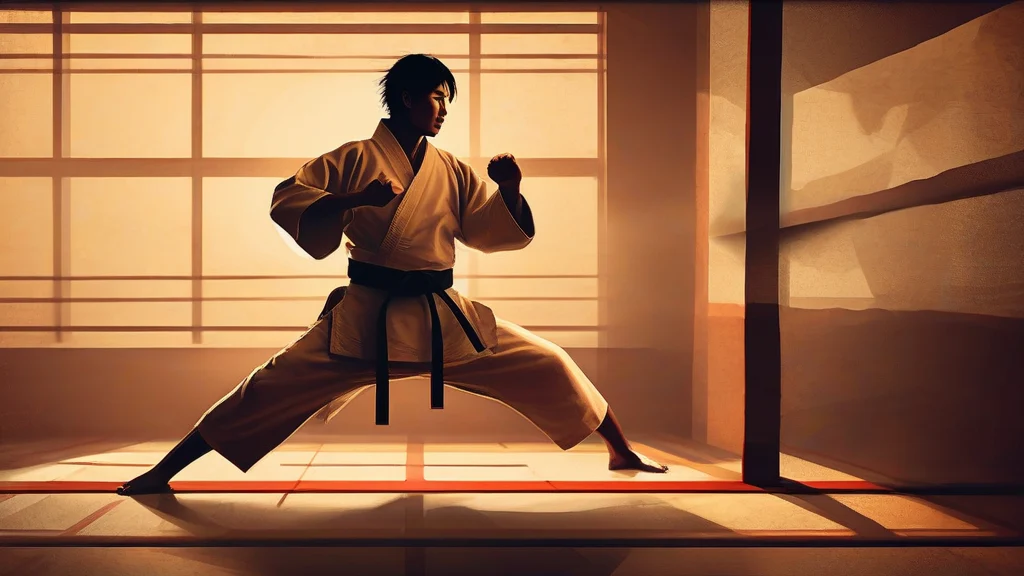
What does karate mean?
Karate is a Japanese martial art that developed through techniques associated with striking, kicking, blocking, and evading. The term comes from Japanese 空手, literally “empty hand,” reflecting the practice of fighting without weapons. Today, karate is learned by children and adults for physical fitness, self-confidence, discipline, and competition, while also appearing in popular films, sports, and cultural traditions. In ordinary English, the word usually refers to the traditional Japanese martial art, though it can sometimes be used more broadly for unarmed combat techniques. A person who performs karate is called a karateka, and the training hall is generally known as a dojo. The word is internationally recognized and has become associated both with a practical method of self-defence and with a discipline requiring concentration, respect, and repeated practice.
nounA Japanese martial art that emphasizes striking, blocking, and other techniques using the hands and feet. In general use, the word can also refer to a style or system of unarmed combat.
- A Japanese martial art emphasizing punches, kicks, blocks, and disciplined training.
- Any style of unarmed combat, especially when the term is used broadly for physical fighting techniques.
"She has practiced karate for years and earned her black belt last month."
"The children learn karate at a local dojo."
"The film features a brief, stylized display of karate."
Rare and usually informal or specialist; the ordinary word is uncountable.
"The performance showcased several different karates."
The name literally means “empty hand,” describing the unarmed discipline that inspired the martial art.
Reviewed by Deb Chak, Editor. AI-assisted content curated by RJS Tech Solutions LLP.
Where does karate come from?
The English word “karate” comes from Japanese 空手, read karate, literally “empty hand.” The compound combines 空, “empty” or “sky,” with 手, “hand,” a reference to unarmed practice. Its English use became established during the 20th century as the martial art spread internationally, especially through postwar cultural exchange. The related forms “karate-ka,” meaning a karate practitioner, and “karate-do,” referring more broadly to the way of karate, also reflect Japanese borrowings.
Related word forms
How karate is actually used
Karate is generally used as an uncountable noun. “A karate” is uncommon, though “karates” is occasionally used in informal or specialist contexts to refer to different styles or performances. In British English, “practise” is commonly used as a verb; American English often uses “practice.”
Easily confused with karate
Karate is the martial art, whereas a karate chop is a hand strike associated with it.