
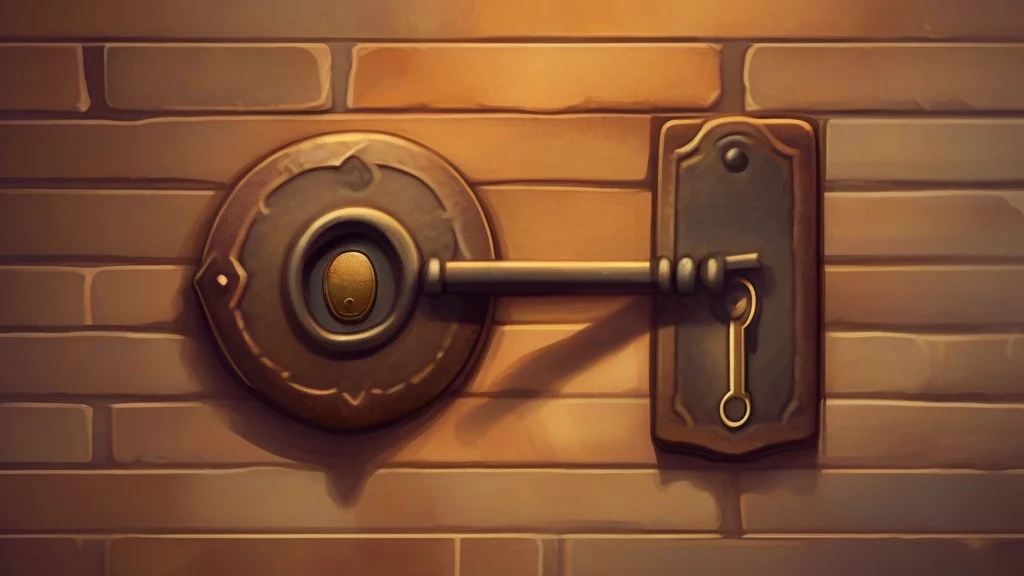
What does key mean?
A key is most commonly a device used to open or lock something, but the word has developed a wide range of related meanings. It can mean a crucial person, fact, or idea, as in “the key to success,” and it can refer to something that solves a problem or provides access to information. In music, a key is the tonal centre around which a composition is organized, while on a keyboard or other device it is one of the buttons used to operate it. A key may also be a map or classification legend, a low-lying island, or a specialized cutting tool. These senses share an underlying idea of access, control, explanation, or importance. Because it can refer both to a literal unlocking device and to the thing that makes a difficult matter understandable, the word is especially useful when discussing both physical and figurative forms of access.
A small device used to open or lock a door, drawer, or other fastening; also, a means of access, solution, or crucial importance.
"The key to the archive was kept by the librarian."
The abstract senses are very common in phrases such as “the key to understanding” and “the key to success.”
To enter data or a command into a computer, telephone, or other device using a keyboard.
"Key your password and then press enter."
This is common in computer and telecommunications contexts.
Crucial, central, or indispensable to achieving a result.
"The final agreement was the key factor in the negotiation."
Usually used before a noun, as in “key issue,” “key factor,” or “key point.”
In a way that is crucial, central, or particularly effective.
"The campaign played a key role in raising public awareness."
This is a less common but established use, usually occurring in combinations such as “key role” rather than as a stand-alone modifier.
The plural is used for multiple devices, meanings, musical keys, map symbols, or other items of the same kind.
"She collected the keys to the doors and cabinets."
From a lock-opening device to the central idea of an entire argument, a key can unlock everything from a door to a mystery.
Reviewed by Deb Chak, Editor. AI-assisted content curated by RJS Tech Solutions LLP.
Where does key come from?
The English word descends from Old English cæg, an old Germanic word with senses connected with fastening and opening devices. The musical and keyboard senses developed as the word was applied to the parts of instruments and mechanisms that could be operated to produce or control something. Later figurative uses, including “key to success” and “the key to the mystery,” extended the idea of a device that unlocks to an explanation, means of access, or crucial factor. Related words such as keyboard, keynote, and keystone preserve the same basic root in modern English.
Related word forms
How key is actually used
The figurative senses are common in formal and informal English. In music, a key is distinct from a scale: the key identifies the tonal centre and its associated notes. The island sense is especially associated with coastal and tropical regions, while the tool and keyboard senses are general in British and American usage.
Easily confused with key
A key is a device or means of access, whereas a quay is a landing place beside a harbour or canal.