
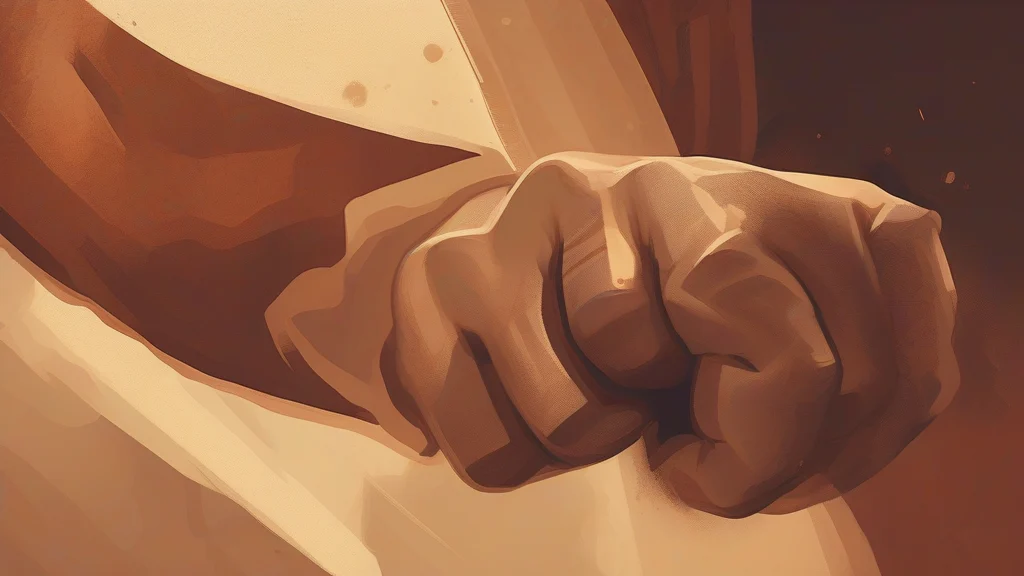
What does knuckled mean?
Knuckled is chiefly an adjective describing hands or fingers whose knuckles are prominent, bruised, or abraded. It can therefore suggest either the visible structure of a hand or the physical evidence of a blow, fall, or prolonged grip. The word is also the past tense and past participle of the verb knuckle, as in knuckled under, meaning to submit or give way under pressure. This latter use is informal and often implies that resistance has finally been overcome. In literary or dramatic contexts, knuckled can evoke severity, determination, pain, or tension. Its common association with white-knuckled gripping further reinforces images of fear, effort, or anxious restraint. Although a straightforward adjective and a regular verb inflection, knuckled is more evocative than many neutral alternatives: it makes the condition of the knuckles feel immediate and physically conspicuous.
Having prominent or clearly defined knuckles, especially as a result of bruising or abrasion.
"The climber's gloves were damp and her hands knuckled."
Often used in vivid descriptions of physical impact, hardship, or tense gripping.
Past tense and past participle of knuckle: to press or strike with the knuckles, or, in the idiom knuckle under, to submit under pressure.
"Eventually, the mayor knuckled under and approved the proposal."
The idiom knuckle under is informal and often carries the connotation of reluctant submission.
Knuckled captures both the shape of a hand and the battered evidence of a hard landing.
Reviewed by Deb Chak, Editor. AI-assisted content curated by RJS Tech Solutions LLP.
Where does knuckled come from?
Knuckled was formed in English by adding the regular inflection -ed to the older word knuckle. Knuckle descends from Middle English knokel and Old English cnucel, which belongs to a family of Germanic words for the prominent joint of a finger. Closely related cognates survive in Dutch knokkel, German Knöchel, and Norwegian knokkel.
How knuckled is actually used
The adjective is relatively uncommon in neutral prose but vivid in descriptions of physical hardship, toughness, or tension. The verbal idiom is informal and conveys reluctant concession or submission.