
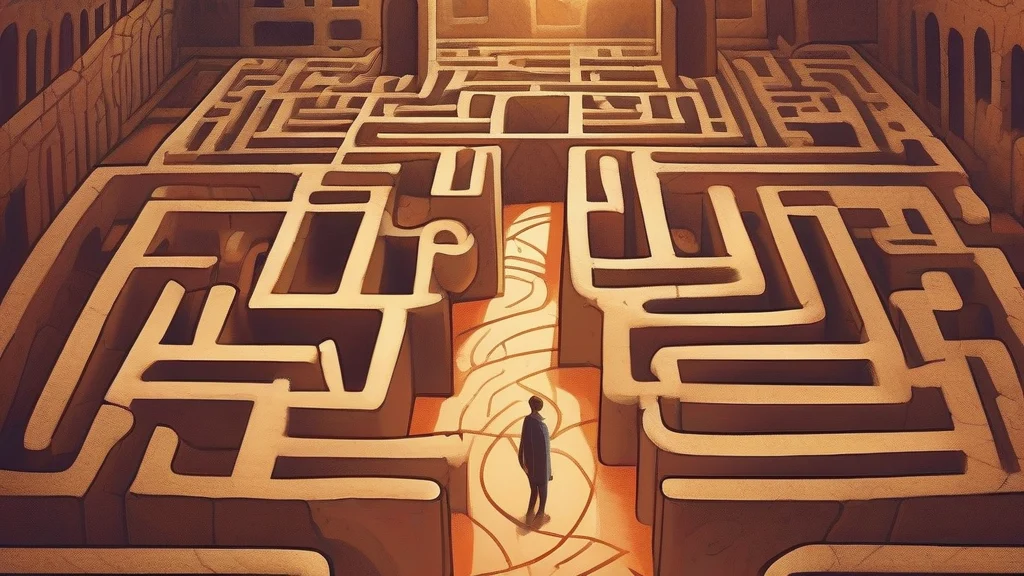
What does labyrinth mean?
A labyrinth is a complicated network of passages, paths, or interconnected spaces that is difficult to navigate. The word also describes figurative situations, organizations, or procedures whose many branches and indirect routes make them confusing to understand. For example, a reader may describe an unfamiliar legal system or administrative process as a labyrinth of rules and exceptions. In ordinary use, a labyrinth is often larger and more elaborate than a maze, although the two words overlap considerably. The term carries connotations of disorientation, complexity, and the possibility of becoming trapped, especially when it is used metaphorically. It can be approving when describing rich, intricate design, as in a labyrinthine garden, but it more often emphasizes difficulty and lack of clarity. The word is also notable for its connection with the ancient Greek story of the Minotaur and the hero Theseus.
nounA complicated network of interconnected passages, especially one that is difficult to navigate. By extension, it refers to a complex organization, process, or situation that is confusing to understand or move through.
- A complicated network of passages or paths that is difficult to navigate.
- A complex organization, process, or situation that is confusing to understand or negotiate.
"She navigated the labyrinth of narrow corridors and eventually found the courtyard."
"The old castle contained a labyrinth of tunnels, secret staircases, and hidden chambers."
"Applicants had to navigate a labyrinth of forms, requirements, and bureaucratic procedures."
The plural is formed by adding -s.
"The library's collection of labyrinths includes maps, optical illusions, and architectural drawings."
The word’s most famous namesake is the legendary Greek labyrinth in which Theseus had to find and defeat the Minotaur.
Reviewed by Deb Chak, Editor. AI-assisted content curated by RJS Tech Solutions LLP.
Where does labyrinth come from?
English labyrinth comes through Latin labyrinthus from Ancient Greek labýrinthos, referring to the winding structure associated with the Minotaur in Greek mythology. The word had entered English by the late 16th century and was initially associated with the mythological labyrinth. Its modern figurative senses developed from the physical idea of intricate passages that are difficult to traverse.
How labyrinth is actually used
The word is literary and somewhat formal in figurative use, where it suggests confusion, complexity, and a lack of straightforward routes. It is sometimes used to imply that a situation is excessively complicated rather than merely challenging.
Easily confused with labyrinth
A maze is a network of passages commonly designed as a puzzle, whereas a labyrinth is more often an intricate place or situation whose scale or complexity makes it difficult to navigate or understand.