
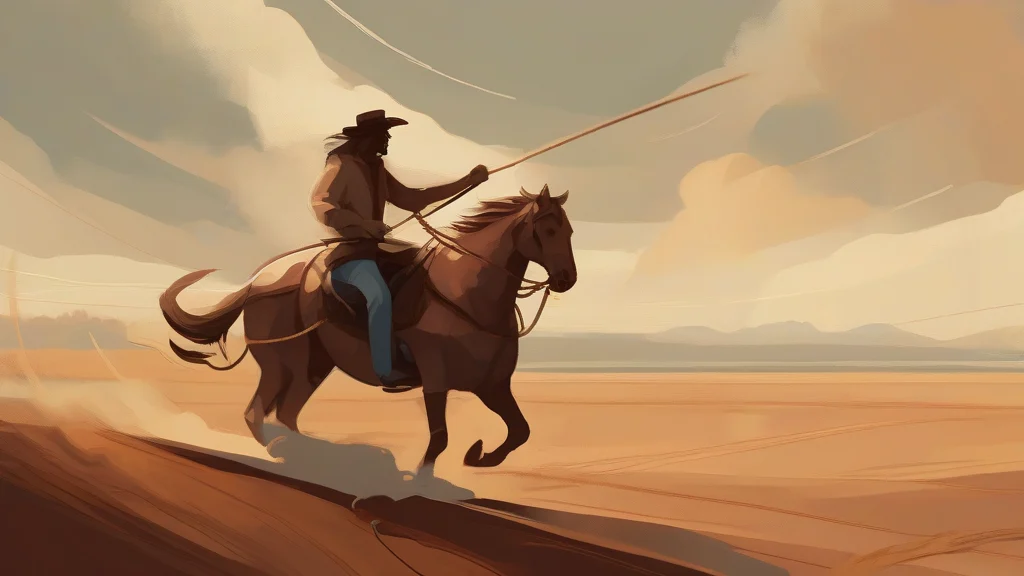
What does lassoed mean?
Lassoed is the past tense and past participle of lasso, meaning to catch or secure someone or something with a loop of rope. Its clearest use is in descriptions of ranch work, where a cowboy lassoes a calf, horse, or other animal. The action is characteristically swift and skillful, involving a rope thrown in a loop that tightens around the target. In figurative contexts, lassoed can mean that a person or thing has been caught, restrained, or brought under control, and it may suggest energetic or determined handling. The word is especially associated with the American West, although the verb itself is understood in British and US English. As a regular verb form, it takes ordinary auxiliary verbs and can appear in constructions such as “has been lassoed” or “was lassoed.”
verbTo catch or secure an animal or person with a lasso. It can also mean to secure something with a rope or cord, especially in a forceful or energetic action.
- To catch or secure an animal or person with a lasso.
- To catch or restrain something with a rope or cord.
- To secure or bring something in with a swift, forceful motion.
"The cowboy lassoed the calf before it could run into the open field."
"He lassoed the stray horse and guided it toward the corral."
"The reporter lassoed the story from several sources before the deadline."
The word comes from the Spanish lazo, meaning “bow” or “loop,” and still carries the image of a loop of rope that can sweep around a moving target.
Reviewed by Deb Chak, Editor. AI-assisted content curated by RJS Tech Solutions LLP.
Where does lassoed come from?
The word comes from Spanish lazo, meaning “bow,” “loop,” or “lasso,” which in turn derives from Latin laqueus, meaning “noose” or “snare.” English borrowed the term through Spanish during the period of Spanish influence in the Americas. The English forms lasso and lassoed developed the familiar modern meanings of catching with a looped rope and its regular past-tense and past-participle inflection.
Related word forms
How lassoed is actually used
The word is most commonly associated with ranching and the American West, but figurative uses are also possible. In the figurative sense, it can suggest a forceful, energetic way of obtaining or securing something.