
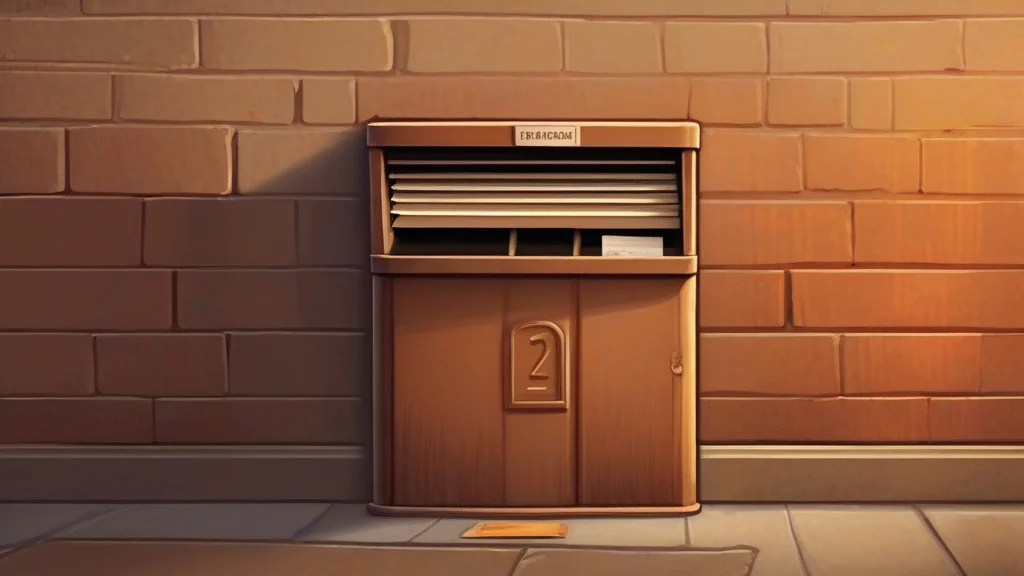
What does letterbox mean?
A letterbox ordinarily means the mailbox or slot where letters and other mail are delivered. The phrase is especially common in British English, although equivalent terms such as mailbox are more usual in the United States. In film and television, a letterbox refers to a presentation format in which a widescreen image appears within a wider display, leaving black bars at the sides. This name derives from the framed openings once used in cinema screens, whose individual panes were called letterboxes. The word can also denote a small, single-person flat in dated British usage. As a verb, to letterbox means to receive correspondence at a specified address or post-office box. Although the modern mailbox is its most familiar referent, the word has long connected both the practical delivery of written messages and the historical architecture of early cinemas.
A box, slot, or compartment where letters and other mail are delivered; a narrow rectangular film format; or, chiefly in dated British English, a small one-person flat.
"She put the bill through the letterbox before opening the front door."
The small-flat sense is chiefly British and now dated. In discussions of film and television, the term usually denotes the format rather than a physical cinema screen.
To receive correspondence at a specified address or post-office box.
"The campaign letterboxed at a central office while volunteers distributed leaflets locally."
This use is established but relatively uncommon in contemporary everyday speech and is especially associated with organizational or temporary mailing arrangements.
The regular plural is used for multiple mail receptacles, cinema or screen openings, and, in dated British usage, small flats.
"The row of letterboxes was fixed to the wall beside the entrance."
Cinema screens were once made from many separate panes, and the vertical frame around them became known as the letterbox.
Reviewed by Deb Chak, Editor. AI-assisted content curated by RJS Tech Solutions LLP.
Where does letterbox come from?
The word was formed in the 16th century from letter and box, reflecting its original use for a receptacle in which letters were placed or received. The film-related sense developed from the early cinema practice of assembling screens from vertical panes framed by wooden strips called letterboxes; the term later came to denote the shape and format of the image. Letter itself descends through Old English and Old French from Latin littera, meaning a letter of the alphabet or a written message, while box has a separate Germanic origin.
Related word forms
How letterbox is actually used
In British English, the term for a small one-person flat was historically associated with people living in modest rented accommodation and is now dated or nostalgic. The verb is chiefly associated with addresses and post-office boxes and is much less common in everyday contemporary usage.
Easily confused with letterbox
A mailbox may be a free-standing container for mail, whereas a letterbox more often denotes the slot or compartment through which letters are delivered.
A letter is the written message itself; a letterbox is the place where mail is received.