
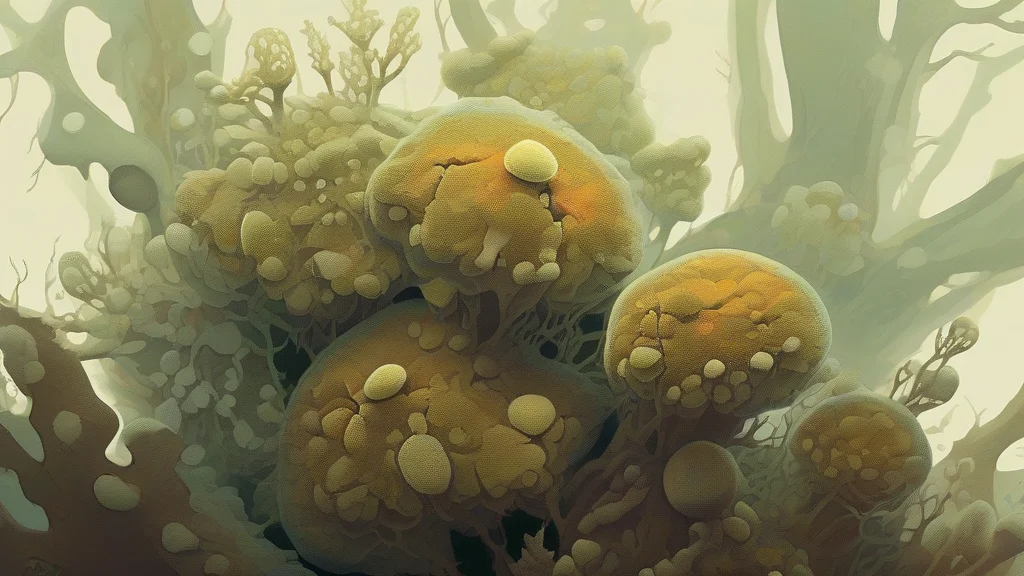
What does lichen mean?
A lichen is a composite organism in which a fungus lives together with an alga or cyanobacterium. The fungal partner provides protection and a structure for growth, while the photosynthetic partner produces food, making the association beneficial to both organisms. Lichens grow on trees, rocks, soil, and other surfaces, and they are especially characteristic of exposed habitats where other large organisms may struggle. They are often described by their colours and textures, such as grey-green crusts, orange patches, and branching shrubby forms. Because lichens absorb much of what they need from the air and surface beneath them, they are commonly used as indicators of environmental conditions, including air quality, although they should not be treated as precise instruments on their own. The word can also refer figuratively to something slow-growing, persistent, or old-fashioned.
A composite organism consisting of a fungus in a mutually beneficial association with an alga or cyanobacterium.
"A pale lichen spread across the damp stone."
The term commonly describes the organism as a whole, although the fungal component alone is technically a lichenized fungus.
A person considered old, slow-moving, or resistant to change.
"The old manager was a lichen who resisted every attempt at modernization."
This figurative use is informal and generally disparaging.
The regular plural is used for both biological organisms and the figurative sense meaning old or unchanging people.
"Several lichens colonised the exposed roof tiles."
A lichen is two organisms living together as one: a fungus provides structure, while its microscopic partner supplies food through photosynthesis.
Reviewed by Deb Chak, Editor. AI-assisted content curated by RJS Tech Solutions LLP.
Where does lichen come from?
The English word lichen comes through Latin from Greek λειχήν (leikhēn), meaning “tree moss” or “lichen.” Greek usage already referred to organisms growing on trees and rocks, and the term entered English in the sixteenth century. The name was later applied scientifically to the distinctive partnership between a fungus and a photosynthetic partner, while the related scientific terms lichenology and lichenologist continue to refer to the study of lichens and those who study them.
Related word forms
How lichen is actually used
In biological usage, a lichen refers to the whole composite organism rather than only its fungal component. The word is also used figuratively for something that spreads or grows slowly, and for a person regarded as old or unchanging in a humorous or disparaging way.
Easily confused with lichen
A lichen is a partnership between a fungus and an alga or cyanobacterium, whereas moss is a plant that grows in dense, leafy tufts.