
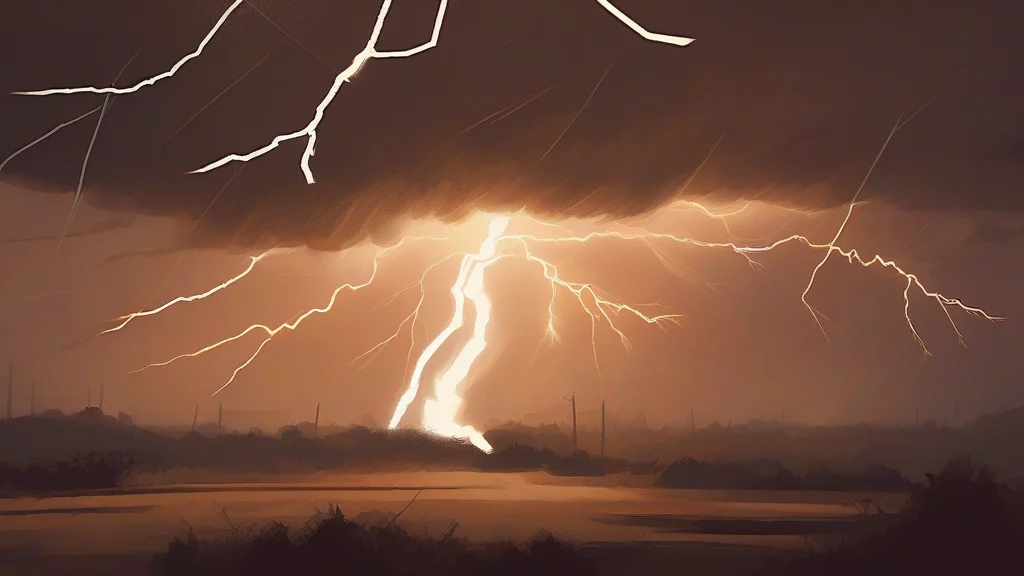
What does lightning mean?
Lightning is the bright, sudden flash produced by an electrical discharge, most often during a thunderstorm. It is commonly associated with the accompanying sound of thunder, although the two occur at different moments because sound travels more slowly than light. In ordinary English, the word is usually uncountable: one says “a bolt of lightning” rather than “a lightning,” and “thunder and lightning” refers to the general weather phenomenon. The word also has a figurative use for a sudden revelation, striking idea, or burst of inspiration, as in “a lightning flash of insight.” Although lightning may occur in clear air as well as within storms, it is most closely associated with thunderstorms and the visible discharge itself, not with the sound of thunder. Its distinctive combination of danger, beauty, and immediacy makes it a powerful word in both factual descriptions and literary language.
A sudden, bright flash of electricity produced during a storm, usually accompanied by thunder; also, figuratively, a sudden striking insight or illumination.
"The lighthouse was briefly obscured by lightning and rain."
Normally uncountable in modern standard English, especially in the expression “thunder and lightning.”
To flash briefly and intensely, like lightning.
"The distant horizon lightning with the storm."
Rare and literary; the verb is much less common than the noun.
The plural is rare in ordinary usage but occurs in literary or poetic contexts.
"Several lightnings illuminated the distant horizon."
A lightning channel can become thousands of degrees hotter than the visible surface of the Sun.
Reviewed by Deb Chak, Editor. AI-assisted content curated by RJS Tech Solutions LLP.
Where does lightning come from?
The word developed in English from the Germanic root represented by “light,” meaning brightness or the absence of darkness, together with a forming element associated with an action or result. In its earlier development, the word referred to a brightening or flashing, and its modern sense gradually became established for the electrical flash associated with storms. The root also appears in words such as “lighten,” “lightless,” and “highlight,” although the precise historical path by which the compound acquired its specialized meteorological meaning is less important than its long-established connection with brightness and sudden illumination.
How lightning is actually used
Usually uncountable when referring to the meteorological phenomenon: “there is thunder and lightning.” The plural “lightnings” is possible in literary or poetic usage but is uncommon in ordinary English. Figurative uses such as “a lightning flash of insight” are established but less frequent than the literal sense.
Easily confused with lightning
Lightning is an electrical discharge during a storm, while lightening means making something lighter or less heavy.
Lightning is a natural electrical flash, while lighting is the system or act of providing illumination.