
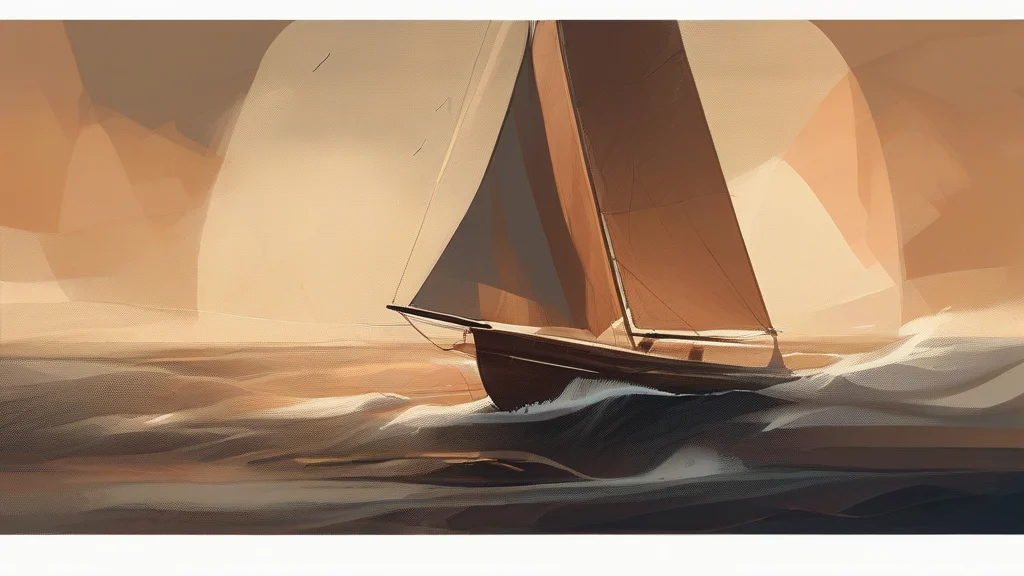
What does luff mean?
A luff is the forward or upper edge of a fore-and-aft sail, the part that runs alongside the mast or spar. As a verb, to luff means to bring a boat's bow into the wind or to sail so close to the wind that the sail loses its proper shape and may begin to flutter. The term belongs mainly to nautical and sailing language, though it is understood by recreational sailors as well. In phrases such as “come up to luff,” the word describes a vessel's movement toward the direction of the wind. A luff can be useful because it slows or redirects a boat, but excessive luffing may leave the sail ineffective. The word is useful for understanding both sailing terminology and the practical distinction between sailing near the wind and sailing efficiently.
The forward or upper edge of a fore-and-aft sail.
"The sailmaker reinforced the luff where it was rubbing against the mast."
Chiefly a nautical term; the precise edge varies with the type of sail.
To bring a vessel's bow into the wind, or to sail so close to the wind that the sail loses its shape.
"The skipper luffed briefly to check the boat's speed before turning away."
Used in sailing and nautical contexts; the sail may flutter when the vessel luffs.
The plural is used when referring to multiple sails or their leading edges.
"The crew inspected the luffs of the sails before the storm arrived."
A sail's luff is its leading edge, and a vessel that luffs too sharply can stall instead of making progress.
Reviewed by Deb Chak, Editor. AI-assisted content curated by RJS Tech Solutions LLP.
Where does luff come from?
The word is recorded in Middle English in forms such as lof and luff, and its development is associated with English nautical usage. It belongs to a Germanic vocabulary of sailing terms connected with the side or edge of a sail, with related forms appearing in other Germanic languages. Modern senses developed from the idea of a vessel turning or sailing toward the wind, causing the sail to lose its wind.
Related word forms
How luff is actually used
This is chiefly nautical terminology. In modern sailing, it often refers to the position of a vessel's bow relative to the wind or to the resulting loss of sail shape. The noun luff is less common outside technical nautical contexts.