
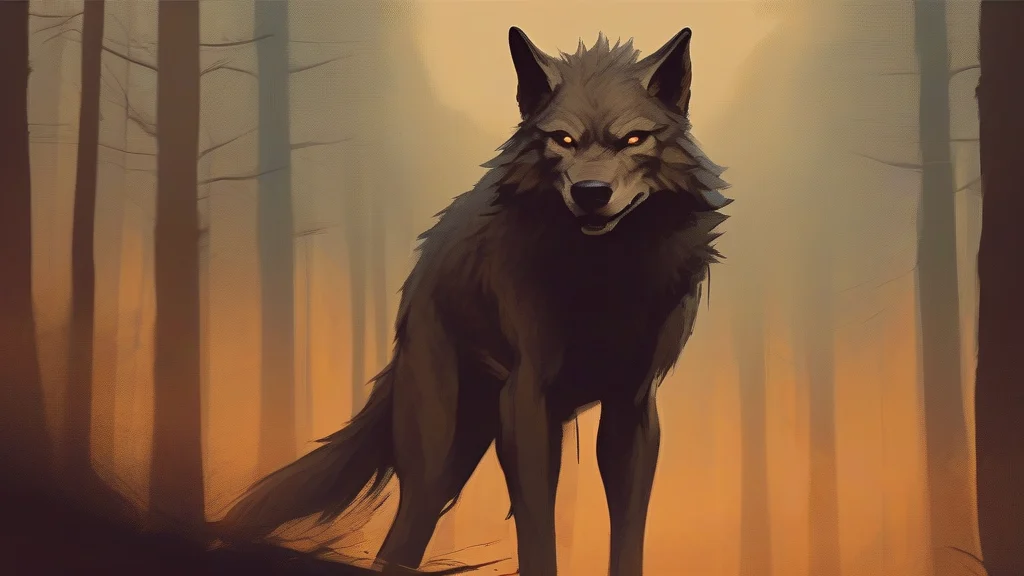
What does lycanthropy mean?
Lycanthropy is the condition or supernatural power of transforming into a wolf. In medieval and modern folklore, it may appear as a curse, a hereditary affliction, or a dangerous gift. The word also has a clinical sense: a delusional belief that one has become or can turn into an animal, especially a wolf. Contemporary writing uses lycanthropy more often in supernatural fiction than in technical discussion, where “lycanthropic delusion” may be preferred. Its connotations combine fear, transformation, and a blurring of human and animal identity. Although the expression can sound fanciful, its roots are ancient and cross-cultural. The word is useful because it names both a specific supernatural condition and the psychological idea of identifying with a nonhuman creature. Understanding that dual history helps readers approach werewolf stories, Gothic literature, and accounts of unusual beliefs with greater precision.
nounThe condition, power, or curse of transforming into a wolf, especially in folklore and supernatural fiction. In a clinical context, it can also refer to a delusional belief that one has become, or can become, a wolf.
- The condition or supernatural power of transforming into a wolf, especially as a curse, affliction, or inherited power in folklore and fiction.
- A delusional belief that one has become a wolf or can transform into a wolf.
"The Gothic novel presents lycanthropy as an inherited curse passed down through generations."
"Legends often describe lycanthropy as a curse that takes hold when the moon is full."
"Her case notes described a delusional lycanthropy in which she believed herself to be a wolf."
The plural is uncommon because lycanthropy is usually treated as an uncountable name for a condition or phenomenon; it is most natural when referring to distinct cases or traditions.
"The exhibition examines lycanthropies described in medieval European folklore."
Lycanthropy literally joins the Greek words for “wolf” and “human,” making every werewolf a meeting of two identities.
Reviewed by Deb Chak, Editor. AI-assisted content curated by RJS Tech Solutions LLP.
Where does lycanthropy come from?
The word dates from the early 17th century and entered English through New Latin as lycanthropia. It comes from the Greek compound lykanthrōpos, meaning “wolf-human,” formed from lykos, “wolf,” and anthrōpos, “human.” The compound was adapted to denote the condition or phenomenon of wolf transformation rather than the transformed creature itself.
Related word forms
How lycanthropy is actually used
The word is specialized and more common in supernatural, literary, historical, and clinical discussion than in everyday speech. Pronunciation varies regionally, with the first vowel commonly realized as either /aɪ/ or /ɪ/.