
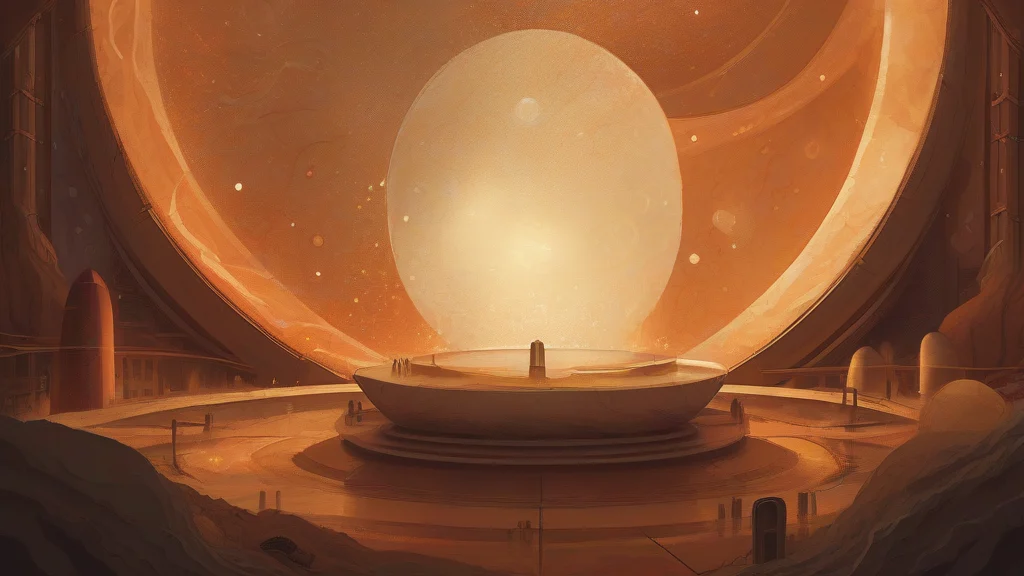
What does macrocosm mean?
A macrocosm is the universe considered as a single, ordered whole. In scientific and philosophical writing, it may also refer to a large-scale model or representation of a system, such as an imagined city designed to mirror the structure of an entire country. The figurative use can describe any large and complex organization whose component parts are interpreted in relation to the whole. Macrocosm is usually contrasted with microcosm, meaning a smaller version or representative part. Although rooted in an old philosophical distinction between the universe and the tiny world once thought to duplicate it, the modern term remains useful for discussing large systems, cosmic order, and the relationship between parts and wholes. Its tone is formal and intellectual rather than conversational, and it often conveys a sense of breadth, complexity, and interconnectedness.
nounThe universe regarded as a complete, ordered whole. By extension, it means a large, complex system or a representation of something at a correspondingly large scale.
- The universe regarded as a complete, ordered whole.
- A large-scale representation of a system, process, or field of activity.
- A large, complex organization or system whose parts are understood in relation to the whole.
"The solar system can be viewed as a miniature reflection of the macrocosm."
"The philosopher argued that human beings occupy a central position in the macrocosm."
"The city planning exhibition presented its proposed design as a macrocosm of the entire country."
Plural forms are used when referring to multiple large-scale representations, systems, or universes.
"The exhibition combines three macrocosms inspired by cities from different periods."
Macrocosm has a miniature opposite: the microcosm, where a small part is imagined as reflecting the structure of the whole.
Reviewed by Deb Chak, Editor. AI-assisted content curated by RJS Tech Solutions LLP.
Where does macrocosm come from?
Macrocosm was formed in the early 17th century from Greek makros, meaning “large,” and kosmos, meaning “world” or “ordered universe.” Its construction was influenced by microcosm, which uses the same Greek elements to mean a small-scale representation of the world. The word belongs to the same etymological family as cosmos, cosmic, cosmology, and microcosm.
Related word forms
How macrocosm is actually used
The word is formal and relatively uncommon in everyday speech. It is especially common in philosophical, scientific, and analytical writing, where it often contrasts with microcosm.
Easily confused with macrocosm
A macrocosm is the universe or a large-scale whole, whereas a microcosm is a small-scale representation or miniature counterpart of something larger.