
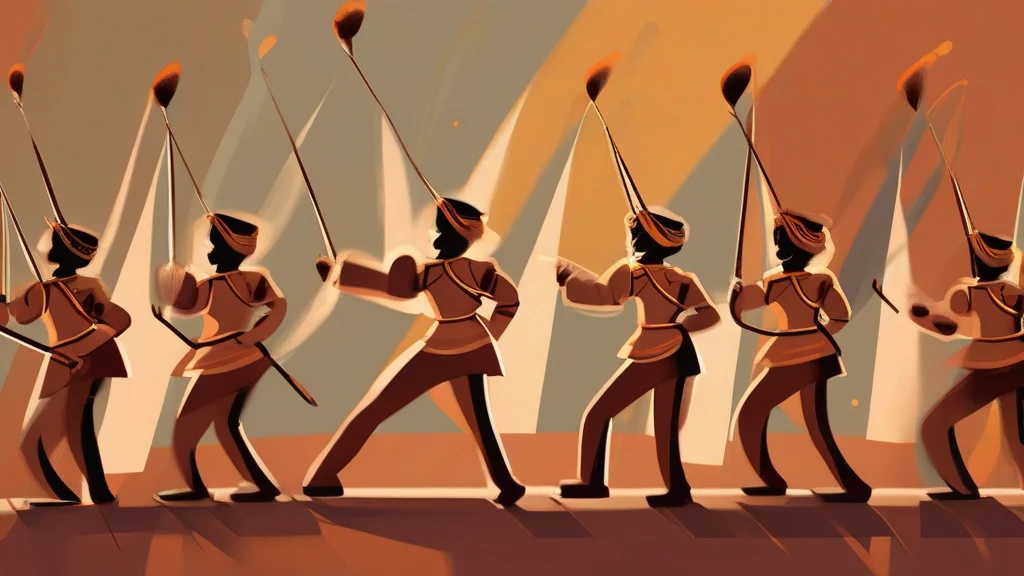
What does majorette mean?
A majorette is a member of a marching band who performs with a baton, often as part of a coordinated group known as a majorette squad. The role traditionally includes twirling, dance movements, and synchronized routines performed while the band marches. Majorettes are commonly associated with school, college, and parade bands, particularly in North America, and are usually distinguished from the drum major, who directs the band and leads its musicians. The modern baton-twirling majorette developed from older traditions of uniformed band auxiliaries whose exact duties varied. Although the term can sometimes be used more broadly for female band members, baton performance remains its clearest association. The word has a long-established place in the culture of school parades, football bands, and public ceremonies, and it evokes both disciplined ensemble movement and decorative showmanship.
nounA member of a marching band who wears a uniform and twirls a baton, often in a coordinated performance. In some bands, majorettes may also perform dance routines or other movements.
- A uniformed member of a marching band who performs with a baton, usually as part of a group.
"The majorette led the parade down the avenue with a series of precise baton twirls."
"The majorette spun the baton in time with the marching music."
"Her school named her head majorette after years of training and competitions."
The usual plural refers collectively to a band or squad of baton performers.
"The majorettes performed a coordinated routine during the halftime show."
A majorette leads the band visually, while the baton becomes her instrument.
Reviewed by Deb Chak, Editor. AI-assisted content curated by RJS Tech Solutions LLP.
Where does majorette come from?
The word was borrowed from French majorette, a diminutive associated with major, meaning a person of high rank or a principal figure. Its application to band performers developed in the early 20th century, when uniformed marching-band auxiliaries became increasingly prominent in the United States. The English noun ultimately connects with major and related Latin-derived words such as majority, all reflecting the idea of greater size, rank, or importance.
How majorette is actually used
The term is especially associated with school, college, and parade marching bands in North America. Although a majorette is conventionally a baton performer, the term is sometimes applied more broadly to uniformed female band members.
Easily confused with majorette
A majorette performs with a baton, whereas a drum major directs the band and may conduct its musicians.