
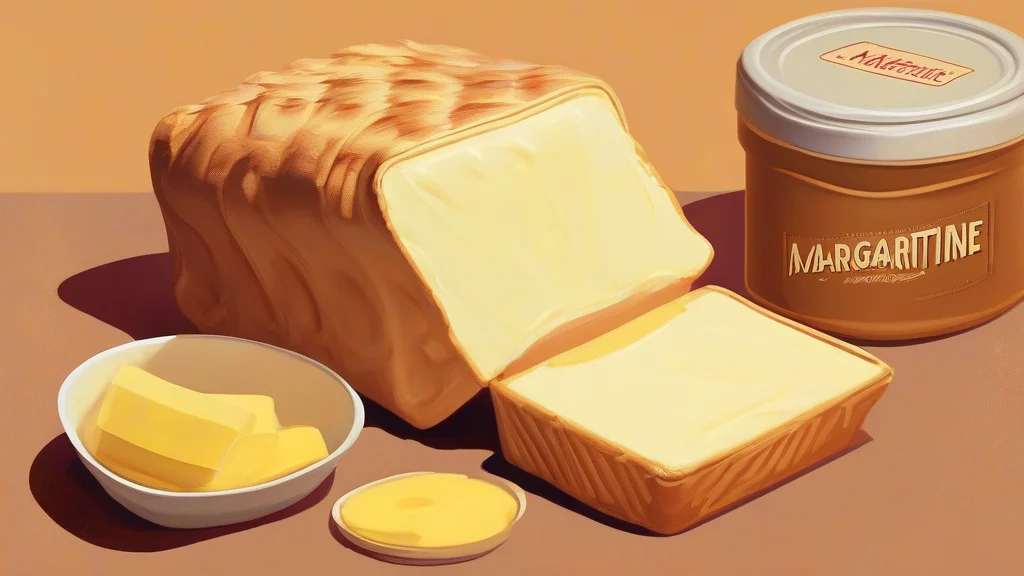
What does margarine mean?
Margarine is a spread made mainly from vegetable oils and commonly used in place of butter. Its texture and flavor vary by product, but it is commonly spread on bread, used in baking, and melted into sauces or cooked dishes. The word can refer both to traditional formulations and to modern plant-based spreads, so the precise ingredients are often clearer from the label than from the name itself. Margarine was developed in the nineteenth century as an alternative to butter, particularly where dairy products were scarce or expensive. The name reflects the spread’s original resemblance to a pearl and comes through French from the Greek margaritēs, meaning “pearl.” Today it is a familiar household term, though some speakers distinguish it from other vegetable-oil spreads using more specific labels.
nounA semisolid food spread made primarily from vegetable oils, sometimes with added milk solids, vitamins, or flavorings. It is used in place of butter.
- A semisolid spread made primarily from vegetable oils and used like butter.
"She spread margarine on the toast before adding the honey."
"The recipe calls for two tablespoons of margarine."
"He used margarine instead of butter in the sandwich."
Plural is used when referring to different products or varieties of margarine.
"The shop stocks several margarines, including unsalted and plant-based varieties."
Margarine was named for its original pearl-like appearance, a clue that survives in its French and Greek-derived name.
Reviewed by Deb Chak, Editor. AI-assisted content curated by RJS Tech Solutions LLP.
Where does margarine come from?
The word comes from French margarine, coined in the nineteenth century by the French chemist Hippolyte Mège-Mouriès for a butter substitute. Its name was chosen from Greek margaritēs, “pearl,” because the original product had a pearly appearance. Related English words include margarite, a mineral or gemstone name, and marginal, which comes through Latin from the same broad family of meanings associated with edges and boundaries.
Related word forms
How margarine is actually used
The term is neutral in most English-speaking regions. Some people use it specifically for traditional margarine containing animal fats, while contemporary products are often entirely plant-based.
Easily confused with margarine
Margarine is a spread made mainly from vegetable oils, whereas butter is a dairy product made from milk and cream.