
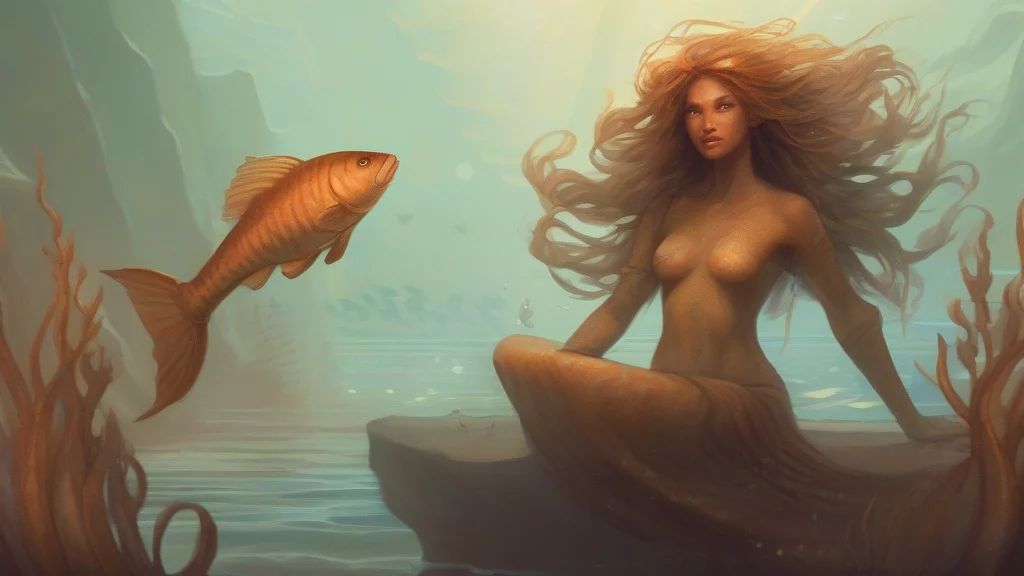
What does merfolk mean?
Merfolk are legendary beings who inhabit the sea and are commonly imagined as having a human upper body combined with a fishlike tail. The word is useful when speaking generally about sea beings of any gender or an entire mythological community: one might describe merfolk in a folktale, a children's fantasy novel, or a discussion of maritime folklore. Merfolk traditions appear in many parts of the world, although the appearance, behavior, and motives attributed to these beings differ considerably between cultures. Some stories portray them as beautiful and musical, while others make them threatening, deceptive, or associated with storms and shipwrecks. The related terms mermaid and merman specify gender, but merfolk is broader and can serve as both a collective and a plural. In modern imaginative writing, the singular a merfolk is also used, especially where a particular character is being introduced. Merfolks is accepted as an alternative plural, though merfolk already functions as a plural form.
nounMerfolk are legendary or mythical humanlike beings who live in the sea, typically depicted with a human upper body and a fishlike tail.
- Legendary or mythical sea beings with human upper bodies and fishlike tails, found in folklore, folklore-inspired fiction, and modern fantasy.
"The old harbor legend tells of merfolk who sing beneath the waves on moonlit nights."
"Children's books often portray merfolk as curious creatures who form friendships with humans."
"The scholarly exhibition examined how merfolk traditions differ across coastal cultures."
Merfolk functions as a plural or collective noun, and merfolks is an accepted alternative plural. The singular a merfolk is also used in modern fiction and folklore.
"The merfolk gathered among the rocks as the storm broke."
Merfolk traditions appear in folklore around the world, turning the sea into a realm of hidden communities, enchanted songs, and transformative encounters.
Reviewed by Deb Chak, Editor. AI-assisted content curated by RJS Tech Solutions LLP.
Where does merfolk come from?
Merfolk is an English compound formed from a sea-related element and the word folk, meaning people. The first element is commonly traced to Old English mere, meaning sea, while folk descends from Old English and denotes a group or community of people. Related formations such as mermaid and merman combine the same sea element with gendered terms, while merpeople is a later, explicitly gender-inclusive expression.
Related word forms
How merfolk is actually used
Merfolk may be used as a plural or collective noun, and merfolks is also an accepted plural form. In modern fantasy and folklore, the singular a merfolk is possible. The term is broader than mermaid because it does not specify gender.
Easily confused with merfolk
A mermaid is specifically a female merfolk, while merfolk can refer to male, female, or unspecified sea beings collectively.