
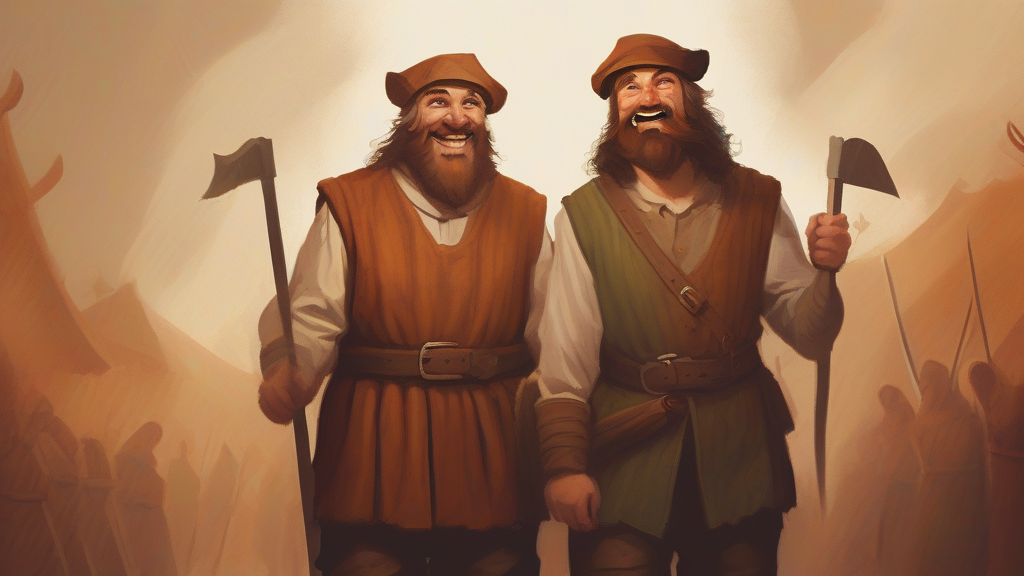
What does merrymen mean?
Merrymen is a plural noun denoting cheerful men, with its strongest association being the band of companions traditionally associated with Robin Hood. In general use, it can refer to a lively or cheerful group of men, though the word is more often encountered in stories, historical retellings, and descriptions of Robin Hood's followers than in everyday speech. The expression carries a romantic, festive, and mildly archaic atmosphere. Its modern sense does not require the individuals to be outlaws, but that context is culturally dominant: Robin Hood's merrymen are remembered as companions who inhabit the forest and support him. Although "merryman" is the singular form, it is rare in general use, while the plural "merrymen" has become especially recognizable through Robin Hood literature and folklore. The word combines "merry," meaning cheerful or joyful, with "man," referring to an adult male.
plural nounMerrymen are cheerful or merry men, especially a band of companions, retainers, or outlaws. The term is most famously associated with Robin Hood and his followers.
- A group of cheerful men.
- The companions or followers of Robin Hood, used especially in historical and literary contexts.
"Robin Hood and his merrymen waited in the forest."
"The merrymen shared the food they had gathered from the passing travellers."
"Local folklore portrays the outlaw and his merrymen ashelpers of the oppressed."
This word is inherently plural and refers to multiple men. The singular "merryman" is uncommon.
"The villagers spoke of the outlaw and his merrymen."
Robin Hood's band was the original celebrity gang of merry companions.
Reviewed by Deb Chak, Editor. AI-assisted content curated by RJS Tech Solutions LLP.
Etymology of merrymen
The compound is formed from "merry," which derives from Old English mirce, meaning pleasant, cheerful, or merry, and "man," which comes from Old English man. The component meanings have remained closely associated with the word, giving it an enduring sense of cheerful male companionship. Its strongest cultural association developed through the Robin Hood tradition, in which the hero's companions became known collectively as his merry men.
Related word forms
How merrymen is actually used
The word is literary, archaic, or folklore-oriented rather than ordinary modern usage. It is normally plural, although the singular form is uncommon outside phrases such as "Robin Hood and his merry men."