
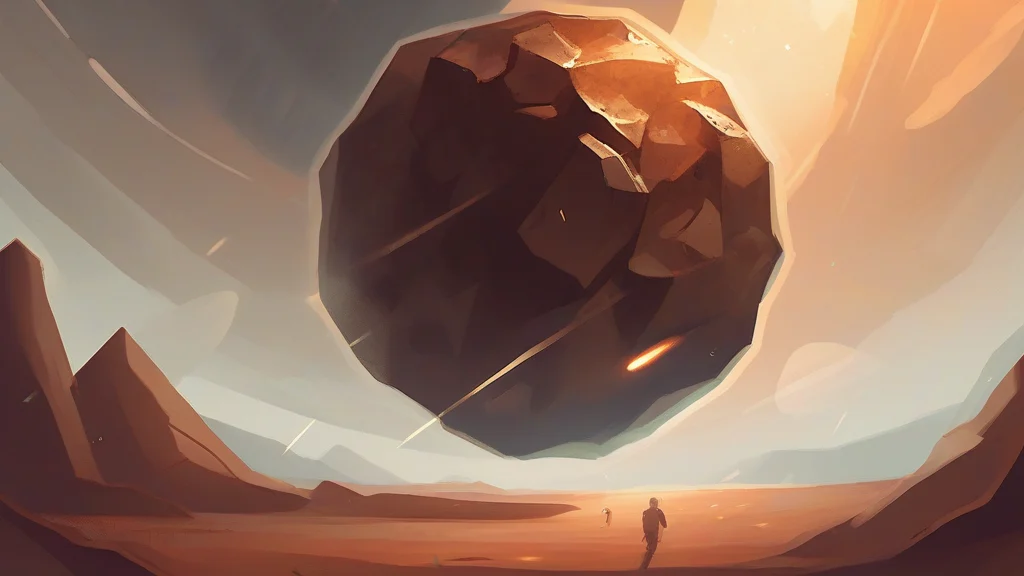
What does meteorite mean?
A meteorite is a solid piece of natural material that travels through space, enters Earth's atmosphere, and survives to reach the ground. The term is most often associated with fragments of asteroids or comets, although material from other planetary bodies can also reach Earth as meteorites. In scientific usage, a meteorite is carefully distinguished from a meteor, the atmospheric light phenomenon, and a meteoroid, the object moving through space before atmospheric entry. Meteorites can be stony, metallic, or a mixture of both, and their composition provides important evidence about the formation and history of the solar system. They are also valued as museum objects, scientific specimens, and cultural artifacts. Although people sometimes use the informal phrase “fallen star” for a meteorite, the scientific description is more precise: it is the surviving fragment of an extraterrestrial object that has landed on Earth's surface.
nounA meteorite is a solid piece of natural material that survives passage through space and reaches Earth's surface, usually originating in an asteroid or comet. It is distinguished from a meteor, which is the light phenomenon produced when material enters the atmosphere, and from a meteoroid, which is the object before it enters the atmosphere.
- A naturally occurring solid object that reaches Earth's surface after passing through space, usually from an asteroid or comet.
"The museum displays a rare iron meteorite that fell in the desert many centuries ago."
"Scientists studied the composition of the meteorite to learn about the early solar system."
"The old farmhouse was built from stones that local residents had long mistaken for ordinary rock, though they were actually pieces of meteorite."
The standard plural is meteorites, used for individual fragments or objects that have reached Earth's surface.
"The collection includes meteorites from several different countries."
Some meteorites are older than the solar system itself, preserving material from the time before the planets formed.
Reviewed by Deb Chak, Editor. AI-assisted content curated by RJS Tech Solutions LLP.
Where does meteorite come from?
The English word meteorite came through French météorite, which was formed from the Greek root for a phenomenon or object appearing in the sky, associated with meteoros, “high up” or “in the heavens.” The suffix -ite was added in the sense of a mineral or natural substance. The word developed in English during the early modern period, alongside earlier expressions such as “meteoric stone,” and later became the standard scientific term for material reaching Earth from space.
Related word forms
How meteorite is actually used
The word is primarily used in scientific, geological, historical, and collecting contexts. It is normally a countable noun, with the plural form meteorites.
Easily confused with meteorite
A meteor is the luminous streak or explosion seen when material passes through Earth's atmosphere, whereas a meteorite is the solid material that reaches the ground.
A meteoroid is a small body moving through space; if it enters the atmosphere, it becomes a meteor, and any surviving fragment that lands is called a meteorite.