
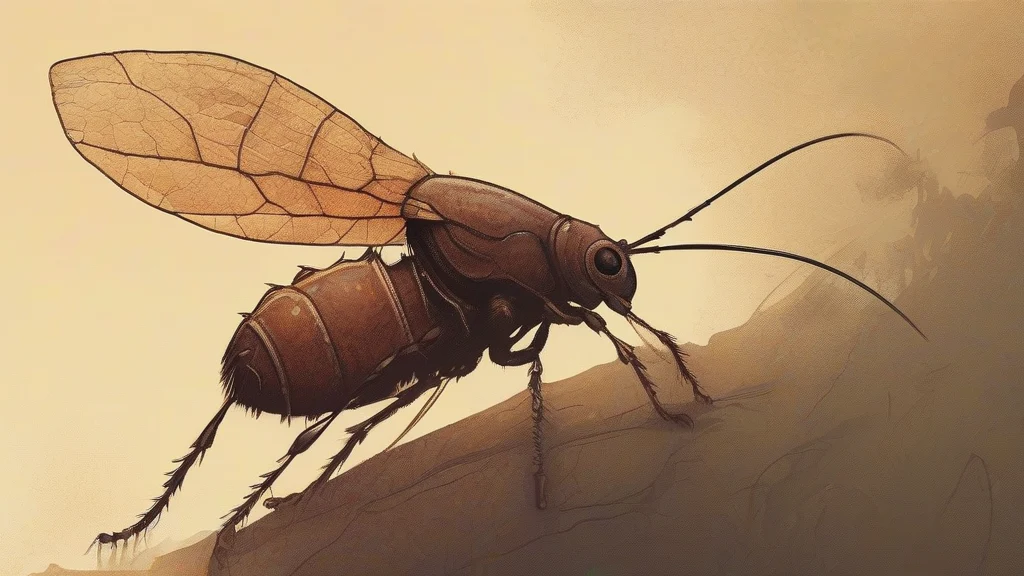
What does mite mean?
A mite is principally a minute arachnid, a relative of spiders and ticks that can live in dust, soil, stored food, plants, or on other animals. Some species cause economic damage or affect humans and animals, while others are too small to notice without magnification. The word also has an idiomatic use in the phrase “a mite of,” meaning an exceedingly small amount: someone may say that a statement contains “not a mite of truth.” In older literary usage, a mite could refer to a person considered insignificant, though this sense is now archaic. Because mite is both the name of a familiar household arthropod and a vivid expression for a tiny quantity, it works well in both factual and figurative writing. Its long-established use in English also makes it especially recognizable when heard alongside its homophone, might, in phrases such as “might as well.”
nounA tiny arachnid of the subclass Acari, many of which live on animals, plants, stored food, or in household dust. By extension, the word can mean an exceedingly small amount or, archaically, an insignificant person.
- A minute arachnid of the subclass Acari, occurring in habitats such as soil, dust, plants, stored food, and the bodies of animals.
- An exceedingly small quantity, as in the phrase “a mite of.”
- Archaically, a person regarded as insignificant or of little importance.
"Not a mite of the food was wasted."
"A single mite can make an entire jacket look threadbare."
"There was not a mite of evidence to support the accusation."
Use the plural for multiple individual arachnids. Expressions such as “a mite of” normally take the singular.
"Dust mites often thrive in warm, humid rooms."
A house-dust mite is too small to see without magnification, yet a thriving population can feed on the flakes of skin in an ordinary mattress.
Reviewed by Deb Chak, Editor. AI-assisted content curated by RJS Tech Solutions LLP.
Where does mite come from?
The word descends from Old English mīte, used for a tiny insect or creature. It was inherited through Proto-Germanic and is cognate with Dutch mijt, German Milbe, and Danish mide. In modern English, the zoological meaning remains central, while the expression “a mite of” developed from the word’s older sense of something minute or insignificant.
Related word forms
How mite is actually used
The zoological sense is ordinary in scientific and everyday contexts. The expression “a mite of” is idiomatic and often carries a slightly formal or literary tone. The sense meaning an insignificant person is now chiefly archaic.
Easily confused with mite
A mite is a tiny arachnid or an exceedingly small amount, whereas might is a modal verb expressing possibility or strength of feeling.
A mite is a small eight-legged arachnid, while a midge is a small two-winged fly, including biting species.