
What does motte mean?
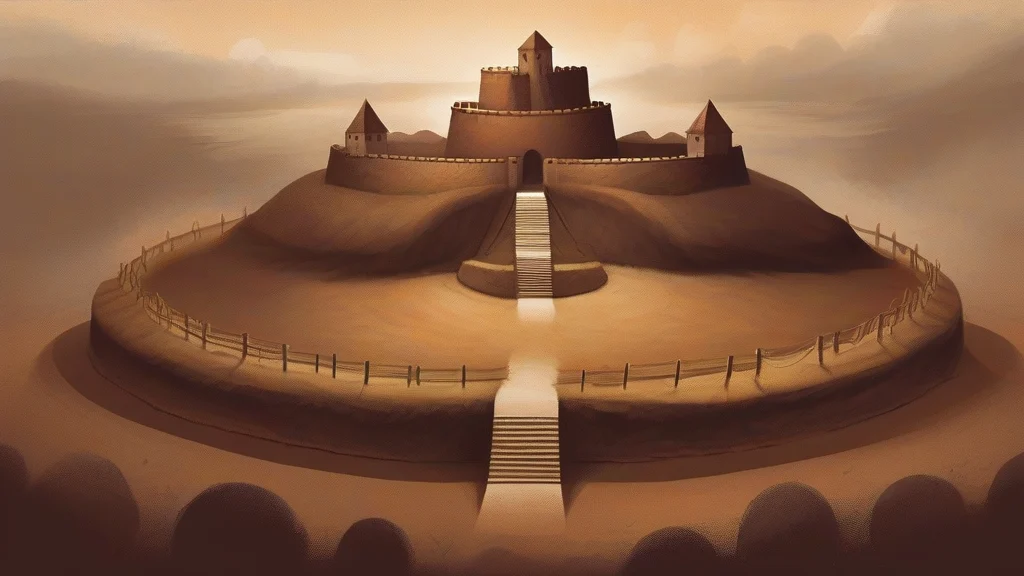
A motte is a mound, most often an artificial one built as a defensive platform. Its principal historical use was the raised earthwork that supported the keep or tower of a medieval castle. In the term motte-and-bailey, the motte contrasts with the bailey, the enclosed courtyard beside it. Although the word can describe a mound more generally, it is strongly associated with fortified settlements and archaeological descriptions of medieval castles. From a strategic perspective, a motte gave defenders height, visibility, and a difficult approach for attackers. Today, the word appears particularly in British and European medieval history, where it helps archaeologists identify the remains of castle sites and understand how earlier fortifications were adapted or replaced.
nounA mound or raised mound of earth, especially one used as a defensive fortification or as the site of a castle or keep. In modern historical usage, it commonly refers to the artificial earthwork on which a medieval castle was built.
- A raised mound of earth, especially the artificial mound supporting a castle or keep.
- An elevated or mound-like place, used less commonly in general descriptions of terrain.
"The motte rises above the surrounding fields, offering a commanding view of the valley."
"Archaeologists excavated the motte and found evidence of a timber keep at its summit."
"The motte-and-bailey settlement controlled an important crossing through the valley."
The plural is mottes, commonly used when referring to multiple defensive earthworks or castle mounds.
"The survey identified several mottes along the ridge."
A motte was not merely a hill: it was a practical medieval engineering solution, raising defenders above the landscape while providing a massive defensive platform.
Reviewed by Deb Chak, Editor. AI-assisted content curated by RJS Tech Solutions LLP.
Where does motte come from?
The English word motte comes through Old French motte, meaning a mound or heap of earth. The Old French term is generally traced to a Latin word associated with a mound or mass of earth. The English form was used in medieval fortification terminology and survives especially in the compound motte-and-bailey. Its Germanic relatives include words connected with mound and amount, reflecting a broader ancestry in the idea of a heap or elevated mass.
Related word forms
How motte is actually used
The word is most common in British medieval archaeology and heritage terminology. In the expression motte-and-bailey, it specifically denotes the mound on which the keep or tower was constructed.
Easily confused with motte
A motte is a mound or fortification, whereas a mote is a tiny particle of dust or another minute speck.