
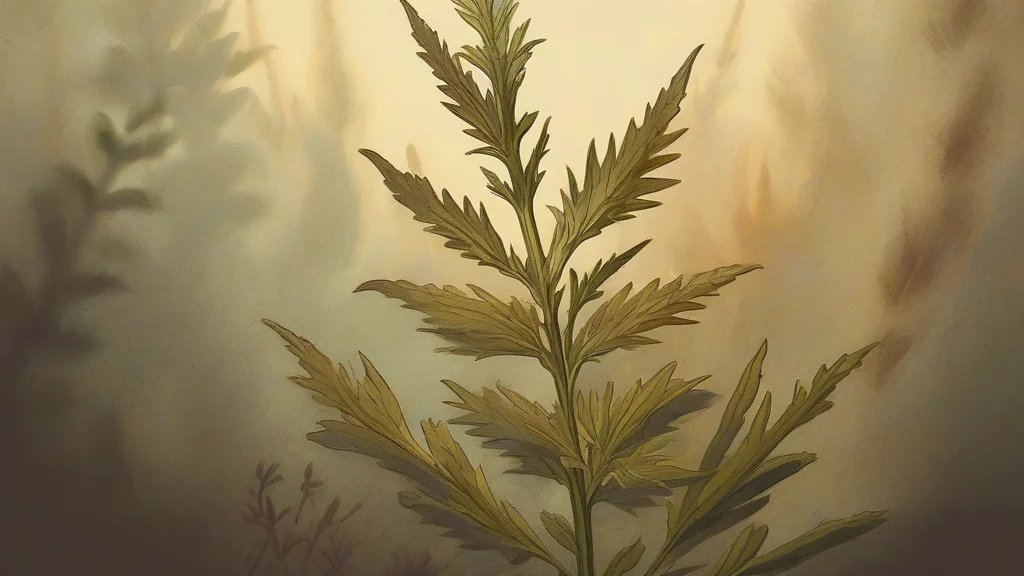
What does mugwort mean?
Mugwort is an aromatic, perennial herb best known by the botanical name Artemisia vulgaris. It has deeply divided, often silvery or grey-green leaves and branching clusters of small yellowish flowers, and it commonly grows in roadsides, hedgerows, waste ground, and other disturbed places. The plant has a long history of use in folk medicine and traditional household practice, including as an infusion and as a source of insect-repellent qualities; it also features in European and East Asian cultural traditions. Modern botanical writing may use “mugwort” more broadly for other closely related species in the Artemisia genus. Although the plant is familiar to gardeners and herbalists, its identity can sometimes be obscured by regional naming and by references in folklore. Recognizing it is useful because it is both botanically distinctive and culturally significant.
nounAn aromatic perennial herb of the genus Artemisia, especially Artemisia vulgaris, with deeply divided leaves and small yellowish flower clusters. Several related species may also be called mugwort.
- The common mugwort, a strongly aromatic perennial herb of the daisy family, especially the species Artemisia vulgaris.
- Any of various other Artemisia species that are commonly given the name mugwort.
"Mugwort grows vigorously along roadsides and in disturbed ground."
"The garden path was lined with tall stalks of mugwort."
"She steeped dried mugwort leaves to make a traditional herbal infusion."
Usually singular when referring to the plant or the species; plural usage is uncommon.
"Several mugworts grew along the roadside."
Mugwort has been associated with traditional protective and household uses for centuries, giving an ordinary roadside weed a surprisingly rich cultural history.
Reviewed by Deb Chak, Editor. AI-assisted content curated by RJS Tech Solutions LLP.
Where does mugwort come from?
The word comes through Middle English from Old English mūgwyrt, a compound formed with an element related to mugwort and wyrt, meaning “herb” or “plant.” The precise origin of the first element is uncertain, but the compound has been used in English since the medieval period. The surviving element wort reflects a wider Germanic vocabulary for plants and herbs, represented in forms such as wyrt and related words in other Germanic languages.
How mugwort is actually used
In modern English, mugwort most often refers to Artemisia vulgaris. The term is also used more broadly for related species, so its precise botanical meaning can depend on context.
Easily confused with mugwort
Mugwort is a flowering herb, whereas a mug is a drinking vessel.