
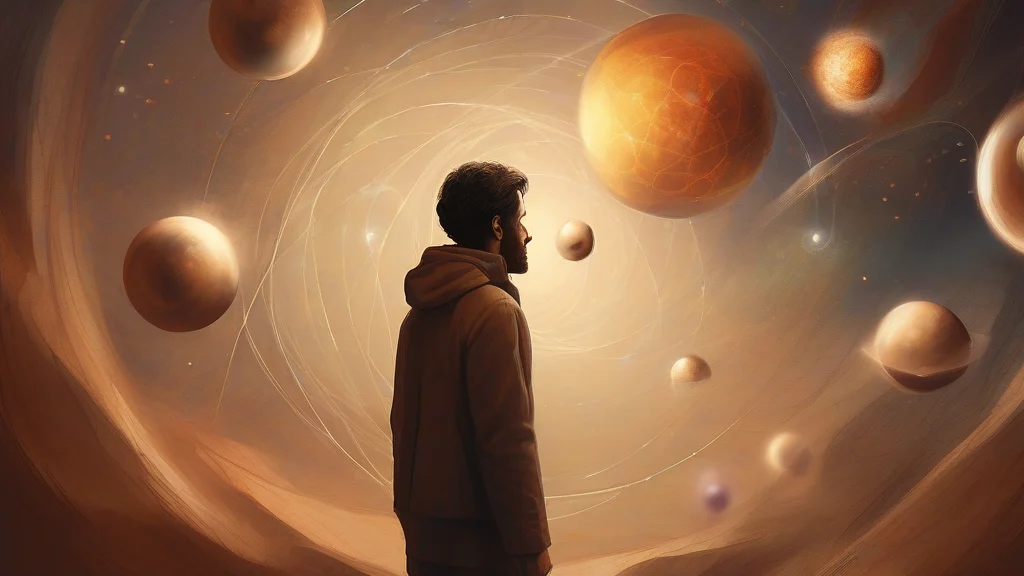
What does multiverse mean?
The multiverse is a theoretical or fictional collection of multiple universes. In cosmology, it can describe a vast set of possible realities that may coexist with our own, sometimes differing in their physical laws, constants, or initial conditions. Some models associated with the many-worlds interpretation of quantum mechanics treat every possible quantum outcome as producing a branching universe, although the word itself does not imply any one scientific theory. In speculative fiction, the multiverse is a setting in which characters encounter parallel worlds, alternate versions of events, or realities with markedly different histories. The concept is especially useful for exploring how events might have unfolded differently and why scientific, philosophical, or fictional questions can have multiple hypothetical answers. As a result, the multiverse often carries associations with both intellectual possibility and imaginative possibility: it is both a subject of theoretical debate and a common device in stories about alternate realities.
nounThe multiverse is the hypothetical collection of all possible universes, or of multiple parallel realities, that may coexist. In physics and speculative fiction, the term can also refer more broadly to a proposed multiverse of universes arising from different physical laws or initial conditions.
- The hypothetical totality of all possible universes or realities.
- A model in cosmology or speculative fiction in which multiple universes coexist, often differing in physical laws, history, or initial conditions.
- A fictional setting containing numerous parallel worlds, realities, or alternate versions of events.
"The physicist explored the possibility that our universe is only one of an immense number of realities within the multiverse."
"The observation might have a different explanation in another branch of the multiverse."
"The novel sends its protagonist on a journey through a multiverse filled with alternate versions of familiar cities."
Used when referring to multiple proposed multiverse models, separate fictional collections of realities, or distinct sets of parallel worlds.
"The speculative-fiction series imagines several multiverses connected by unstable portals."
The multiverse turns a single reality into a possibility space: our universe may be one branch among countless alternatives.
Reviewed by Deb Chak, Editor. AI-assisted content curated by RJS Tech Solutions LLP.
Where does multiverse come from?
The word combines the Latin-derived prefix multi-, meaning “many,” with universe, which comes from Latin universum, meaning “the whole” or “all things.” The compound reflects the modern idea of a collection of many universes. Universe itself was borrowed into English through Old French, while universal and university are later derivatives of the same Latin root.
How multiverse is actually used
The word is primarily used in cosmology, philosophy, science fiction, and fantasy. Its use in physics often refers to hypotheses that are speculative rather than empirically established, and in fiction it commonly describes realities governed by different events, histories, or physical rules.
Easily confused with multiverse
A multiverse is a theoretical or fictional collection of universes, whereas the metaverse is a shared virtual environment in which users can interact.