
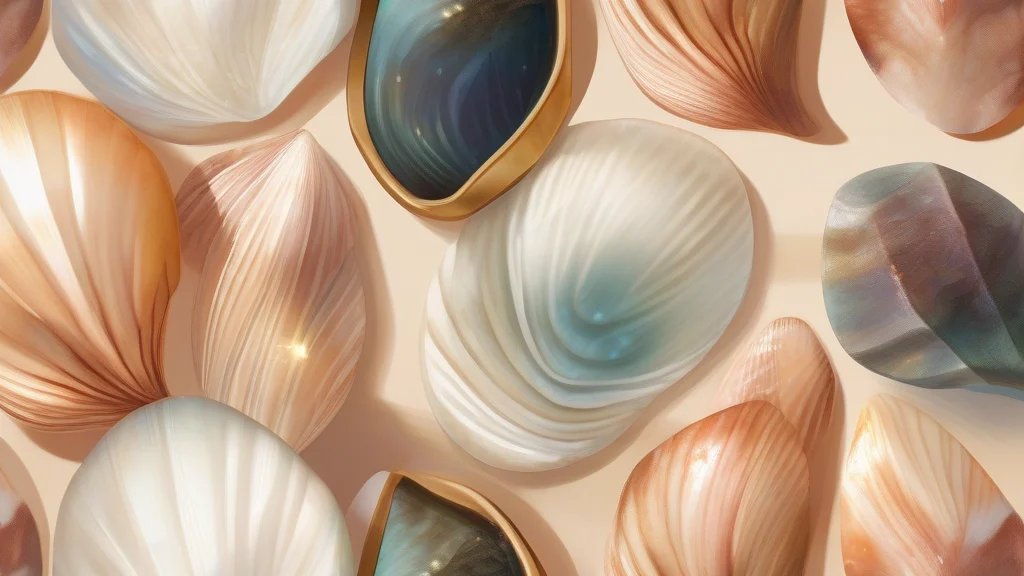
What does nacre mean?
Nacre is the pearly, iridescent material found on the inner surface of mollusk shells, particularly those of oysters and abalone. Better known in everyday language as mother-of-pearl, it consists of extremely thin layers of aragonite crystals held together by an organic matrix. This structure produces both nacre’s distinctive shifting colors and its remarkable toughness, allowing shells to withstand impacts without shattering easily. The light effects visible in nacre result from interference within its layered structure, while its layered architecture has inspired research into strong, lightweight composites. Traditionally, nacre has been highly valued for jewelry, inlay work, buttons, and decorative objects because it can be cut, shaped, and polished to reveal changing colors. Although mother-of-pearl is the more familiar term, nacre is useful when precision is needed to refer specifically to the layered shell material itself or to its properties as a composite. The word is chiefly encountered in scientific, craft, and luxury-goods contexts rather than in general conversation.
nounNacre is the hard, iridescent material forming the inner layers of many mollusk shells, especially oysters and abalone. It is also known as mother-of-pearl and is used in jewelry, decorative objects, and the manufacture of composite materials.
- The iridescent material forming the inner layer of a mollusk shell; mother-of-pearl.
"The jeweller inlaid a crescent of nacre into the lid of an ebony box."
"The interior of the abalone shell consists of thin layers of lustrous nacre."
"Scientists studied nacre because its remarkable strength and crack resistance inspire lightweight composite materials."
Rare; nacre is normally used as an uncountable mass noun. The plural may distinguish separate pieces or objects made from nacre.
"The artisan mounted two small nacres in a silver setting."
Nacre is nature’s microscopic armor: shimmering aragonite platelets turn a mollusk’s shell into a living jewel.
Reviewed by Deb Chak, Editor. AI-assisted content curated by RJS Tech Solutions LLP.
Etymology of nacre
Modern English borrowed the word from French nacre, meaning mother-of-pearl. French nacre passed through Medieval Latin nacrum, which came from Ancient Greek nēkron, a word for a shell or mollusk. Greek nēkron is related to nekros, meaning dead, the root also underlying English cognates such as necrosis and necrotic.
Related word forms
How nacre is actually used
Nacre is chiefly used in specialist contexts such as materials science, jewelry, crafts, and the description of shells. It is normally a mass noun, although a plural occurs rarely.