
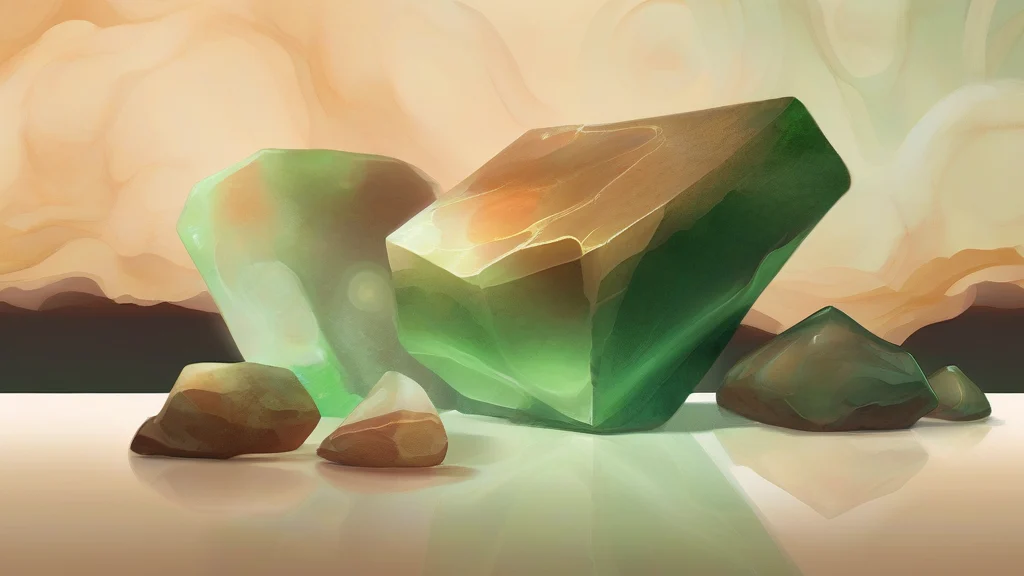
What does nephrite mean?
Nephrite is a hard, compact mineral variety of jade, composed principally of fine-grained tremolite and sometimes actinolite. Its interlocking crystals produce a material that ranges in colour from white and pale green to deep green and is especially well suited to carving because it is tough, takes a smooth polish, and resists breaking. Historically, nephrite was worked into beads, pendants, vessels, tools, and other objects in many parts of the world, including China, New Zealand, and North America. Its name derives from Greek, in which nephros means “kidney”; the mineral was long associated with the body and believed to possess healing properties for kidney and urinary ailments. Today, the term is used chiefly in geology, mineral collecting, jewellery, and the study of carved artefacts. Although often called simply “jade,” nephrite is distinct from jadeite, the other major mineral traditionally grouped under that name.
nounNephrite is a tough, compact variety of jade consisting mainly of fine-grained tremolite or actinolite. It is valued for carving and has traditionally been believed to have medicinal properties associated with the kidneys.
- A tough, compact variety of jade composed mainly of fine-grained tremolite or actinolite, used especially for carved objects and ornaments.
"The museum displays an intricately carved bowl made of green nephrite."
"Collectors prize nephrite carvings for their rich colours and smooth, durable surfaces."
"The necklace combines polished nephrite with silver and was made by a contemporary jeweller."
The plural is used when referring to multiple specimens, objects, or varieties of nephrite.
"The collection includes nephrites from several well-known jade-producing regions."
Nephrite takes its name from the Greek word for kidney, reflecting centuries-old beliefs that this green stone could treat kidney ailments.
Reviewed by Deb Chak, Editor. AI-assisted content curated by RJS Tech Solutions LLP.
Where does nephrite come from?
Nephrite entered English in the early 19th century from French néphrite, which was based on the Greek nephros, meaning “kidney.” The name reflects the mineral’s ancient association with the kidneys and its supposed medicinal powers. The combining form nephro-, meaning “kidney,” survives in English words such as nephrology, nephritis, nephron, and nephrectomy.
How nephrite is actually used
Nephrite is a specialist mineralogical and lapidary term. In general usage, it is one of the two minerals commonly described as jade, the other being jadeite.
Easily confused with nephrite
Nephrite is a fibrous variety of jade composed mainly of tremolite or actinolite, whereas jadeite is a distinct sodium-aluminium silicate mineral.