
What does newt mean?
A newt is a small salamander, an amphibian closely related to frogs and toads. Newts have smooth or slightly rough, moist skin, a long tapering tail, and usually four limbs. They are commonly found around ponds, streams, damp woods, and garden ponds, where they may feed on insects, worms, and other small invertebrates. In British and American English, 'newt' is both a familiar general name and the name used in many common species names, such as the smooth newt and common newt. The word can also function as a mildly dismissive informal term for an unpleasant or insignificant person, although this use is more characteristic of British English. Its name belongs to a Germanic vocabulary that also produced the related English word 'eft,' traditionally associated with a young or small salamander. The term is useful both as a precise identification in natural-history writing and as part of vivid figurative language.
nounA newt is a small, slender salamander with a long tail, moist skin, and typically four legs. The term is especially common for the European and North American newts, including species such as the smooth newt and the common newt.
- A small salamander with a long tail, moist skin, and four legs.
- An informal term for an unpleasant or insignificant person, especially in regional British usage.
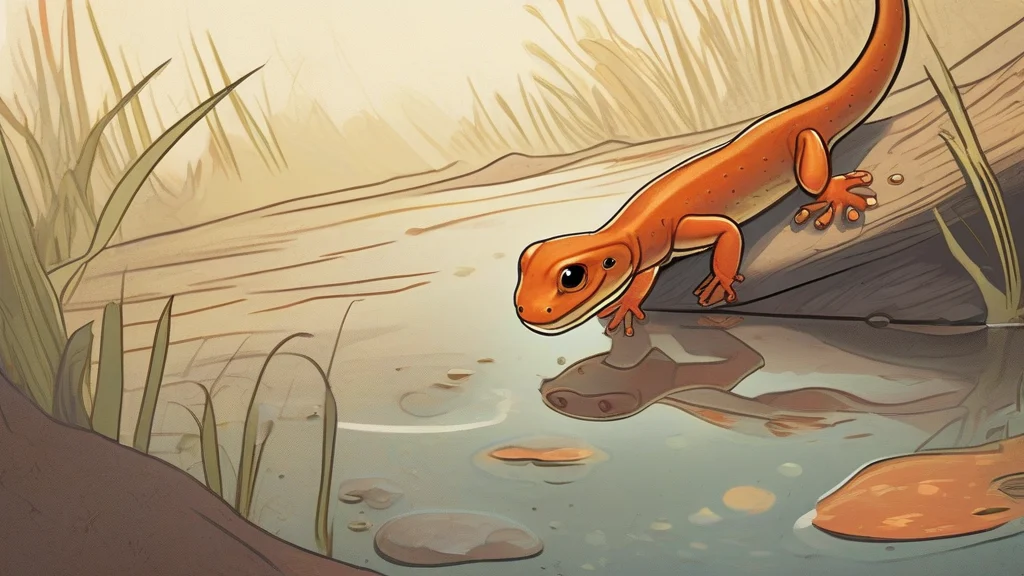
"A newt rested on the damp log beside the pond."
"The children searched for a newt in the shallow water."
"The old garden was full of frogs, snails, and newts."
The standard plural is 'newts.'
"Several newts were hiding beneath the aquatic plants."
The word 'newt' shares its Germanic ancestry with 'eft,' a traditional term for a young salamander.
Reviewed by Deb Chak, Editor. AI-assisted content curated by RJS Tech Solutions LLP.
Where does newt come from?
The word is Middle English in origin and belongs to the Germanic vocabulary for small salamanders. It is historically related to Old English 'eft,' with the modern form developing through medieval spellings and pronunciation changes. The same Germanic roots are reflected in related words in other Germanic languages, including forms meaning an eft or small salamander.
How newt is actually used
In biological contexts, 'newt' is a standard general term used in both British and American English. It can also be used figuratively or informally for an unpleasant or insignificant person, particularly in British English.
Easily confused with newt
An eft is a young newt or a small salamander, while a newt is the more general name for the animal and its various species.