
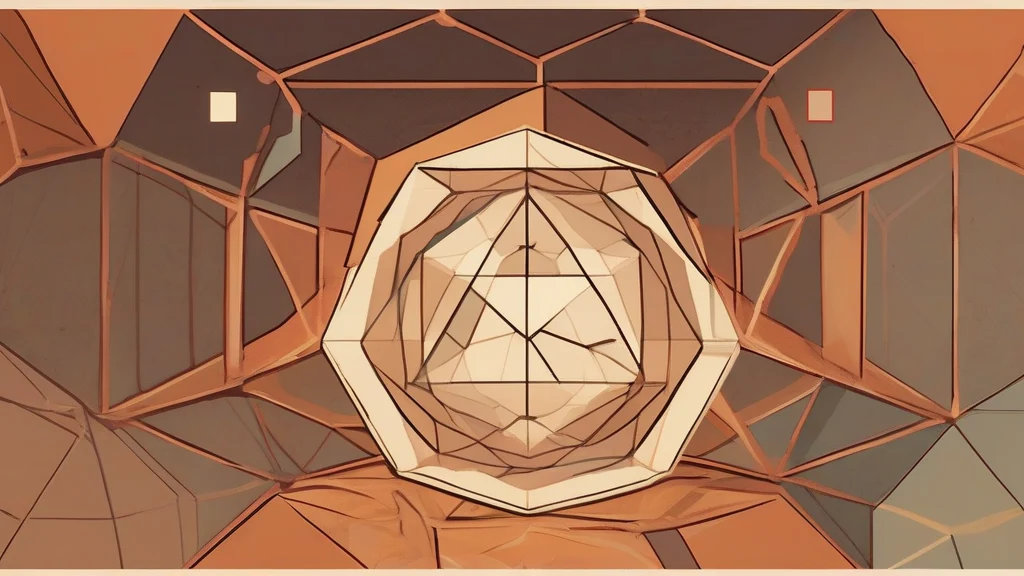
What does nonagon mean?
A nonagon is a polygon—a closed plane figure made from nine straight line segments and nine interior angles. The term is primarily used in geometry, especially when classifying regular and irregular nine-sided shapes or discussing angles, symmetry, and area. A regular nonagon has nine equal sides and equal interior angles, each measuring 140 degrees; an irregular nonagon does not. In ordinary speech, nonagon is a technical noun rather than everyday vocabulary, and it is countable: one can draw a nonagon, while plural nonagons refers to multiple such figures. Its name combines a form meaning “ninth” with the geometric suffix -gon, meaning “angle” or “side,” a construction familiar from triangle, pentagon, and hexagon. Knowing nonagon therefore adds a precise term for nine-sided geometry and reveals the shared Greek and Latin roots behind a family of polygon names.
nounA polygon with nine sides and nine angles.
- A geometric polygon having nine sides and nine angles.
"The architect designed the central courtyard as a regular nonagon."
"Students calculated the interior angles of a regular nonagon in the geometry lesson."
"The unusual nonagon appears in the center of the mosaic."
The standard plural of the countable noun nonagon.
"Several nonagons were arranged around the perimeter of the courtyard."
A nonagon does exactly what its name says: it has nine sides and nine angles—an unusually literal polygon.
Reviewed by Deb Chak, Editor. AI-assisted content curated by RJS Tech Solutions LLP.
Where does nonagon come from?
The word dates from the late sixteenth century. It was formed in English from Latin nōna, the feminine form of nōnus meaning “ninth,” together with the Greek combining form -gōn, meaning “angle.” Enneagon is a related Greek-based name for the same nine-sided figure, while decagon, heptagon, and other polygon names share its Greek geometric suffix.
Related word forms
How nonagon is actually used
This is primarily a formal or technical term used in mathematics, architecture, design, and geometry. It is not regionally restricted, although the alternative enneagon is less common in modern English.
Easily confused with nonagon
A nonagon is a nine-sided polygon, whereas a nonagenarian is a person who is 90 years old.