
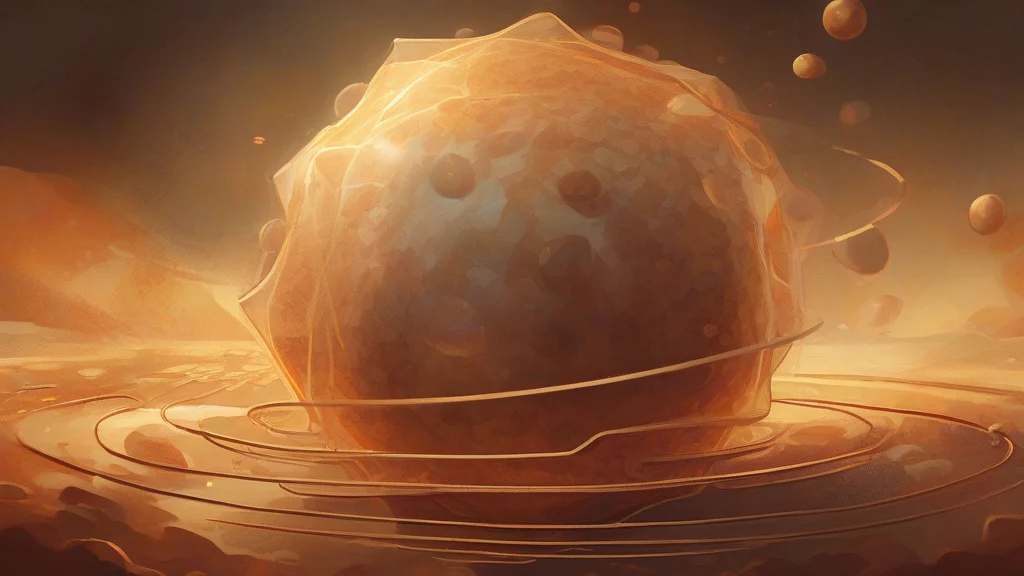
What does nucleation mean?
Nucleation names the process by which something begins to form around an initial nucleus or point of organization. Its most technical use is in physics, chemistry, and materials science, where nucleation describes the formation of tiny clusters that may grow into a new phase, such as a crystal, droplet, or bubble. The exact details depend on the system, but nucleation is often the crucial early step controlling how quickly and in what form a material develops. The word can also be used more broadly and metaphorically for the beginning of a larger process. Its origin in the Latin word for a small kernel or central part connects its scientific meaning with the broader idea of a structure arising from a tiny beginning.
nounThe process of forming or beginning to form a nucleus, especially the initial formation of a new phase or structure. In physics and chemistry, it refers to the formation of small clusters of particles that can develop into a larger phase, such as a crystal.
- The process of forming a nucleus or the initial stage in the formation of something.
- The formation of small clusters of particles in a physical or chemical system, especially in a liquid or supersaturated solution.
- The process by which a new phase begins to develop within a material.
"The formation of ice crystals began with nucleation in the supercooled water."
"Researchers studied the nucleation of ice in clouds to better understand cloud formation."
"Careful control of nucleation is essential for producing high-quality semiconductor crystals."
Usually used in technical contexts for separate instances or sites of nucleation.
"Different impurities created multiple nucleation sites in the material."
In materials science, tiny beginnings can determine the properties of an entire crystal, making nucleation a small process with outsized consequences.
Reviewed by Deb Chak, Editor. AI-assisted content curated by RJS Tech Solutions LLP.
Where does nucleation come from?
Nucleation was formed in English from nucleus, meaning a small kernel or central part, with the suffix -ation indicating a process or action. Nucleus comes from Latin and is a diminutive of nux, meaning nut or seed. Related English words such as nuclear and nucleic were also derived from the same Latin stem, reflecting the shared idea of a central or fundamental part.
Related word forms
How nucleation is actually used
The term is most common in technical and scientific contexts, especially physics, chemistry, materials science, and atmospheric science. In general writing, it can sound formal or metaphorical when referring to the beginning of a process.
Easily confused with nucleation
A nucleus is the structure or central part itself, whereas nucleation is the process by which such a structure or phase begins to form.