
What does nucleotide mean?
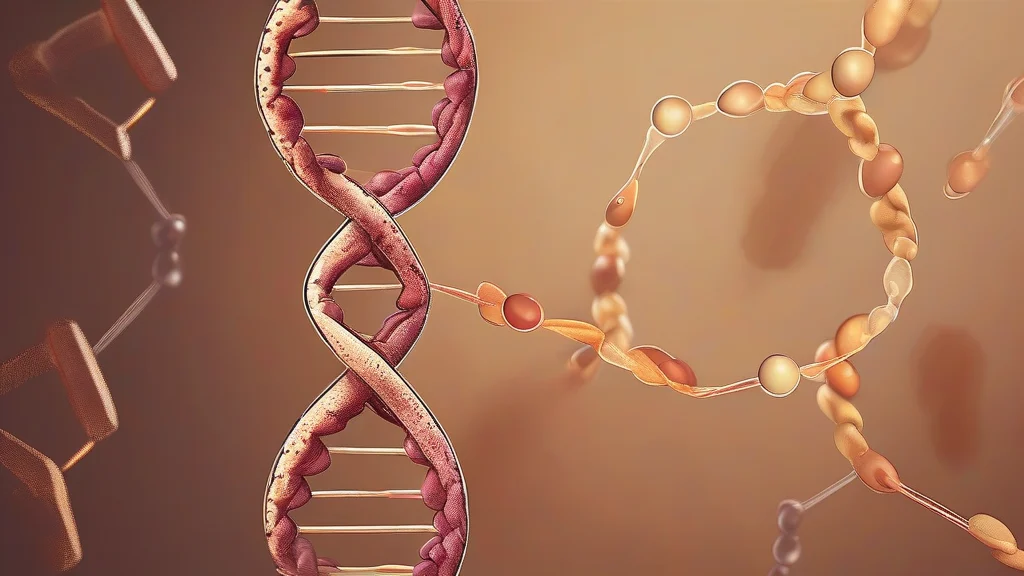
A nucleotide is one of the small molecular building blocks from which DNA and RNA are constructed. Each nucleotide contains a nitrogenous base, a five-carbon sugar, and one or more phosphate groups. The arrangement of nucleotides in a nucleic-acid chain carries genetic information, while different nucleotide compounds also function as cellular energy carriers and signaling molecules. In DNA, the bases adenine, cytosine, guanine, and thymine form the familiar genetic sequence; RNA uses uracil in place of thymine. The word is chiefly used in biochemistry, genetics, medicine, and molecular biology. Outside specialist contexts, it has little everyday use, but it provides a precise name for the molecular units that make up the genetic material of living organisms.
nounA nucleotide is an organic molecule composed of a nitrogenous base, a five-carbon sugar, and one or more phosphate groups. Nucleotides are the basic structural units of DNA and RNA and also participate in cellular energy transfer and signaling.
- A molecule consisting of a nitrogenous base joined to a pentose sugar and one or more phosphate groups, serving as a structural unit of DNA or RNA or as a participant in cellular energy and signaling reactions.
"Each nucleotide in the DNA molecule contains one of four bases: adenine, guanine, cytosine, or thymine."
"Researchers identified a mutation in a nucleotide that altered the function of the gene."
"The enzyme produced a short chain of nucleotides that was then used to synthesize the target protein."
The plural is used when referring to multiple molecular units, whether the units belong to one nucleic-acid chain or to different molecules.
"The researchers sequenced millions of nucleotides from the patient's genome."
Every A, C, G, or T in your DNA is a nucleotide, so your genetic code is written from billions of these tiny molecular building blocks.
Reviewed by Deb Chak, Editor. AI-assisted content curated by RJS Tech Solutions LLP.
Where does nucleotide come from?
English formed nucleotide in the early 20th century from Latin nucleus, meaning “kernel” or “nucleus,” combined with the chemical suffix -ide. The nucleus element links it to related terms such as nucleoside, nucleobase, and nucleoplasm, all of which refer to parts or phenomena associated with the cell nucleus.
Related word forms
How nucleotide is actually used
This is a technical term used primarily in biochemistry, genetics, and molecular biology. In general writing, it is usually more natural to specify the relevant type, such as a DNA nucleotide or an energy-carrying nucleotide.
Easily confused with nucleotide
A nucleoside contains a nitrogenous base and a sugar but no phosphate group, whereas a nucleotide also contains one or more phosphate groups.