
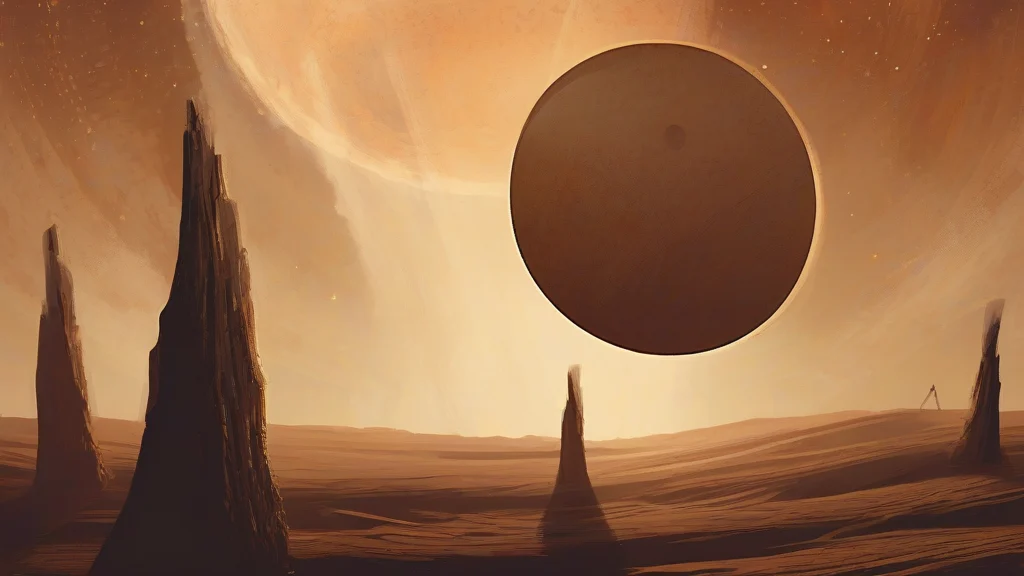
What does occultation mean?
An occultation is the temporary hiding of one celestial body behind another. The best-known examples occur when the Moon passes in front of a bright star or planet, briefly blocking it from view for observers on Earth. Astronomers use timed observations of occultations to investigate the sizes, shapes, and atmospheres of distant objects, and to refine measurements of orbital positions. The word can also be used more generally for concealment or obscuration, though it is more familiar in the precise technical sense associated with astronomy. Unlike an eclipse, which occurs when one body enters another's shadow, an occultation is defined by one body appearing in front of another. The term is consequently associated with fleeting visual disappearances and the precise observation of events that happen quickly and predictably.
nounThe event in which one celestial body passes in front of another and temporarily hides it from view, especially when the Moon passes in front of a star or planet.
- The temporary hiding of one celestial body by another as seen from Earth or another observing location.
- More generally, the act of concealing or obscuring something from view.
"The observatory recorded the brief occultation of the bright star as the Moon crossed its path."
"Astronomers used precise instruments to time the occultation of a distant star."
"The mountain's outline was briefly lost in an occultation of mist."
Used when referring to multiple astronomical hiding events or instances of concealment.
"The observatory catalogued several occultations of stars by the Moon."
When the Moon briefly steals a star from view, astronomers call the disappearing moment an occultation.
Reviewed by Deb Chak, Editor. AI-assisted content curated by RJS Tech Solutions LLP.
Where does occultation come from?
The word comes through Latin from occultatio, a noun meaning “a hiding” or “concealment.” That form was derived from occultare, “to hide,” whose deeper Latin roots are related to the idea of covering something from view. The English scientific sense developed from the observation of celestial bodies becoming hidden behind one another.
How occultation is actually used
In astronomy, the term is most commonly used for the apparent passage of one body in front of another, particularly a planet or satellite in front of a star. In general literary use, it is formal and may describe an act of concealment or disappearance from view.
Easily confused with occultation
An eclipse involves one celestial body entering another body's shadow, whereas an occultation involves one body passing in front of another and blocking its light.