
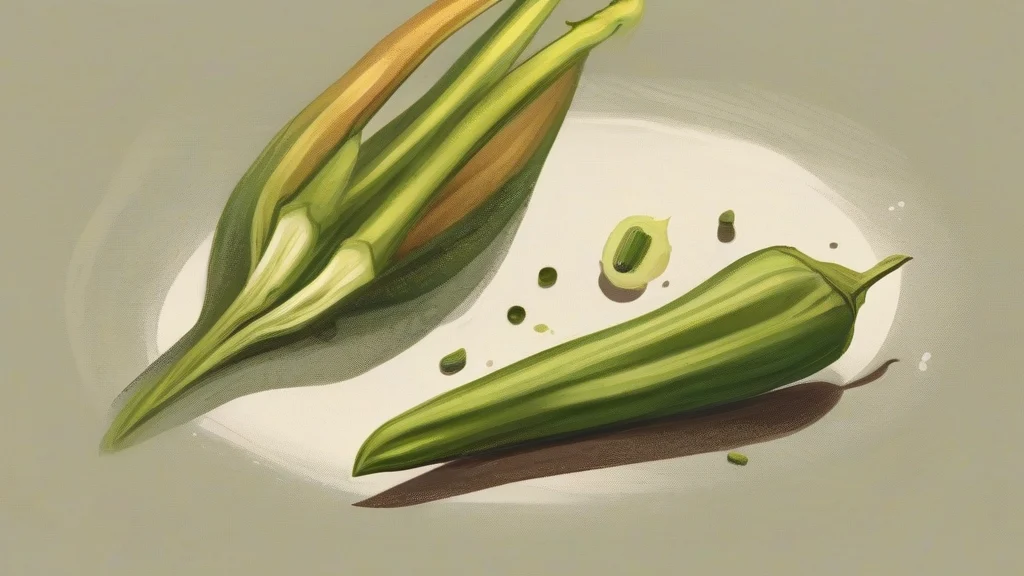
What does okra mean?
Okra is a warm-climate vegetable consisting of the tapered, ridged pods produced by a plant in the mallow family. Its flesh is tender when young and becomes firmer as the pod matures, with a mild flavour and a slightly mucilaginous texture that can thicken soups, stews, and sauces. Okra is central to several regional cuisines, including those of the southern United States, the Caribbean, West Africa, the Middle East, and South Asia, where it is commonly served with grains, legumes, seafood, or highly seasoned sauces. It can be fried, boiled, pickled, or added to dishes such as gumbo. The word also denotes the plant itself. Okra is generally regarded as a nutritious food rich in fibre, vitamins, and plant nutrients, although the health claims attached to it should not be overstated.
nounOkra is the edible pod of a mallow-family plant, usually eaten green and often cooked into stews, soups, or fritters. The word can also refer to the plant that produces these pods.
- The edible green pod of the okra plant, eaten fresh or cooked.
- The plant itself, cultivated in warm climates for its pods.
"She sliced the okra lengthwise and added it to the richly seasoned gumbo."
"We served okra, black-eyed peas, and cornbread with the meal."
"The okra plants grew quickly once the soil began to warm."
"Okras" is used for multiple individual pods; in culinary descriptions, "okra" is also commonly used collectively and may be treated as mass or uncountable when referring to the vegetable.
"The vendor arranged the fresh okras in small bundles."
Okra's name preserves its West African origin: the English word was borrowed through American Spanish from an Igbo term for the plant.
Reviewed by Deb Chak, Editor. AI-assisted content curated by RJS Tech Solutions LLP.
Where does okra come from?
The English word entered through American Spanish, which had borrowed it from a West African language. Its ultimate source is generally identified as an Igbo term for okra, reflecting the crop's long history in West African agriculture before its wider international cultivation. English usage became established during the eighteenth century.
How okra is actually used
In the southern United States, the Caribbean, and parts of the Middle East and South Asia, okra is a familiar staple vegetable. In British English it is less common, and the alternative name "lady's finger" is also widely used internationally. The name "bhindi" is common in South Asia.