
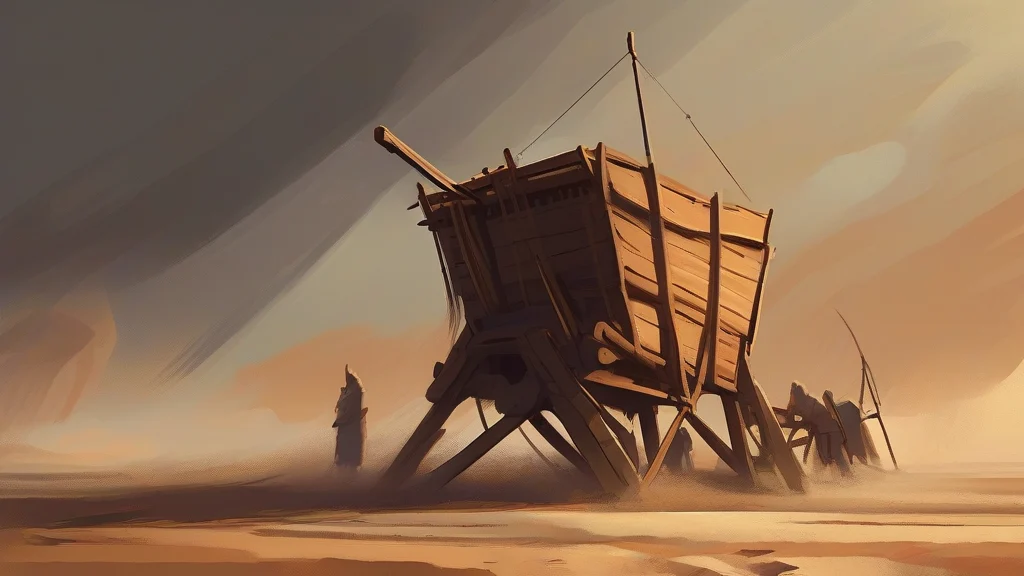
What does onager mean?
Onager has two established senses. In modern zoological writing, it means a member of the Asiatic wild-ass group, Equus hemionus, whose range once extended across much of southwestern and central Asia. Regional populations are commonly distinguished as Persian, Syrian, and other subspecies, although the broader classification has changed over time. The species is associated with open, arid landscapes, and several surviving populations remain threatened. In historical writing, an onager is an ancient stone-throwing siege engine, particularly the Roman catapult-like machine that gave the animal-derived name to this class of weapon. The word is therefore unusual in carrying both an animal and a weapon meaning, with the zoological sense generally prevailing in contemporary specialist contexts. It is most useful in conservation biology, zoology, and the history of warfare. A reader encountering it in a wildlife report should think of a wild ass, while in an account of an ancient siege it means a powerful engine for hurling stones.
nounAn Asiatic wild ass, especially a member of the species Equus hemionus. Also, historically, an ancient stone-throwing siege engine of a type used by the Romans.
- An Asiatic wild ass belonging to Equus hemionus, a group native to the arid and semi-arid regions of western and central Asia.
- An ancient stone-throwing siege engine, especially the Roman form of catapult.
"The field team watched an onager trot across the salt flats before it disappeared into the reeds."
"The field team tracked the Syrian onager across the dry plain."
"Roman engineers built an onager to hurl stones at enemy fortifications."
The regular plural is used for multiple animals or multiple siege engines.
"The sanctuary protects a small population of Syrian onagers."
One word can name both a threatened wild ass and an ancient engine built to hurl stones.
Reviewed by Deb Chak, Editor. AI-assisted content curated by RJS Tech Solutions LLP.
Where does onager come from?
English borrowed the word from Latin onager, meaning “wild ass”; the Latin word comes from Ancient Greek onagros, likewise meaning “wild ass,” although the deeper origin of the Greek term is uncertain. The same name was also applied to a Roman stone-throwing siege engine. French onagre and Spanish onagro continue the Latin word, while Persian onagar has been compared as a related form.
How onager is actually used
The zoological sense is current in specialist wildlife and conservation writing, while the siege-engine sense is chiefly historical. The word is uncommon in everyday speech.