
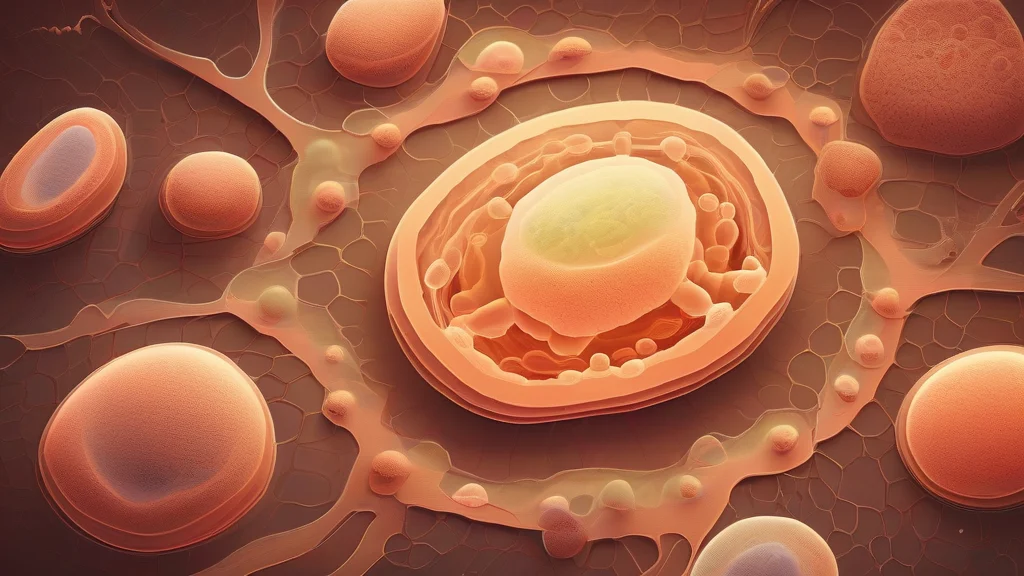
What does organelle mean?
An organelle is a specialized structure inside a cell that performs a defined function. Some organelles, including the nucleus, mitochondria, and endoplasmic reticulum, are enclosed by a membrane; others, such as ribosomes, are not. The term helps describe how a cell is organized: the cell contains genetic material, proteins, energy-producing structures, and systems for making, transporting, and recycling cellular materials. Organelles are therefore central to explanations of cell biology, genetics, metabolism, and disease. Although organelles can sometimes be copied or divided by a cell, they are not independent organisms; they depend on the cell in which they operate. In less technical contexts, the word can also refer broadly to any specialized internal part of a biological cell.
nounA specialized structure within a cell that performs one or more specific functions. Organelles may be surrounded by a membrane, as in mitochondria and the nucleus, or may not be, as in ribosomes.
- A specialized subcellular structure that carries out a particular cellular function, such as energy production, protein synthesis, or transport.
"Mitochondria are organelles that produce much of the energy available to a cell."
"The nucleus is the organelle that contains most of a eukaryotic cell's genetic material."
"Researchers studied how the organelles of the cell change under stress."
The plural is used when referring to multiple specialized structures within one or more cells.
"The cell's organelles carry out energy production, transport, and protein synthesis."
Every cell is a tiny workshop, and its organelles are the specialist stations where essential work gets done.
Reviewed by Deb Chak, Editor. AI-assisted content curated by RJS Tech Solutions LLP.
Where does organelle come from?
The word organelle comes through French from Greek organon, meaning "tool" or "instrument," combined with a diminutive-forming suffix. The underlying root also appears in cognates such as organ, organic, and organism. In biological usage, the term developed to name specialized structures within cells, paralleling the older sense of an organ as a functional part of a larger body.
Related word forms
How organelle is actually used
The term is chiefly used in biology and medicine. In general writing, it is usually used with a specifying expression such as "membrane-bound organelle" or "a cell organelle."
Easily confused with organelle
An organelle is a specialized structure within a cell, whereas an organ is a body structure composed of multiple tissues, such as a heart or liver.