
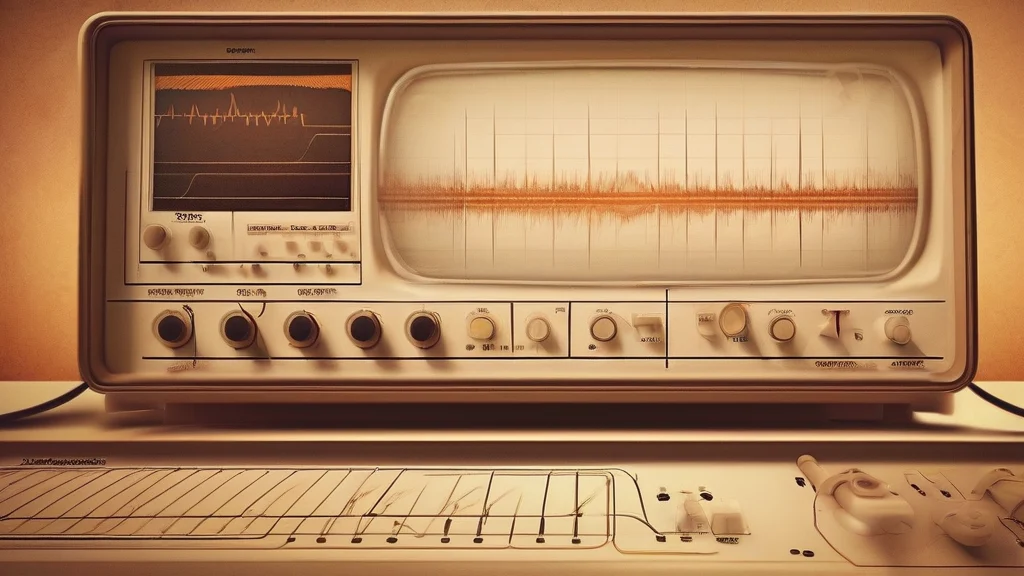
What does oscilloscope mean?
An oscilloscope is an electronic measuring instrument that makes changes in an electrical signal visible. It commonly displays voltage on the vertical axis and time on the horizontal axis, producing a waveform that reveals features such as frequency, amplitude, timing, noise, distortion, and pulses. Technicians use oscilloscopes to test circuits, diagnose faults, verify signals, and investigate systems in electronics, telecommunications, audio engineering, and many scientific applications. The term is also used more broadly for some instruments that display other rapidly changing quantities, such as sound pressure, but its classic use is in observing electrical signals. Unlike a conventional meter, which usually gives a single numerical reading, an oscilloscope shows how a signal evolves over time. Its name reflects this function: “oscillate” refers to variation or swinging, while the ending “-scope” means looking or examining.
nounAn electronic instrument that displays electrical signals as waveforms, usually showing how voltage varies over time. It is used to examine, measure, and troubleshoot signals in circuits and other systems.
- An electronic instrument that represents electrical signals, especially voltage changes over time, as visible waveforms.
"The technician connected the probe to the circuit and watched the waveform on the oscilloscope."
"The engineer used an oscilloscope to check the timing of the digital circuit."
"The oscilloscope showed a rapidly changing signal that was not present in the original recording."
The plural is used when referring to multiple instruments or a collection of testing equipment.
"The laboratory has several oscilloscopes for testing electronic circuits."
The word ends in “scope,” from the Greek idea of looking or examining, while “oscillate” refers to swinging or varying back and forth: an oscilloscope lets you look at signals that move.
Reviewed by Deb Chak, Editor. AI-assisted content curated by RJS Tech Solutions LLP.
Where does oscilloscope come from?
The word is a compound of “oscillate” and “-scope.” “Oscillate” derives from Latin, where the family of words refers to swinging or moving to and fro, while “-scope” comes from Greek skopein, “to look at,” and ultimately appears in many English names of instruments used for observation. The combination was adopted for instruments that made oscillating electrical signals visible.
Related word forms
How oscilloscope is actually used
Usually used in technical contexts such as electronics, telecommunications, engineering, and audio equipment. In general discussion, it may be confused with a chart or monitor that shows data, but technically it specifically displays signals as waveforms or time-varying traces.
Easily confused with oscilloscope
An oscilloscope displays an electrical waveform electronically on a screen, whereas an oscillograph traditionally records a trace on a physical medium such as paper.