
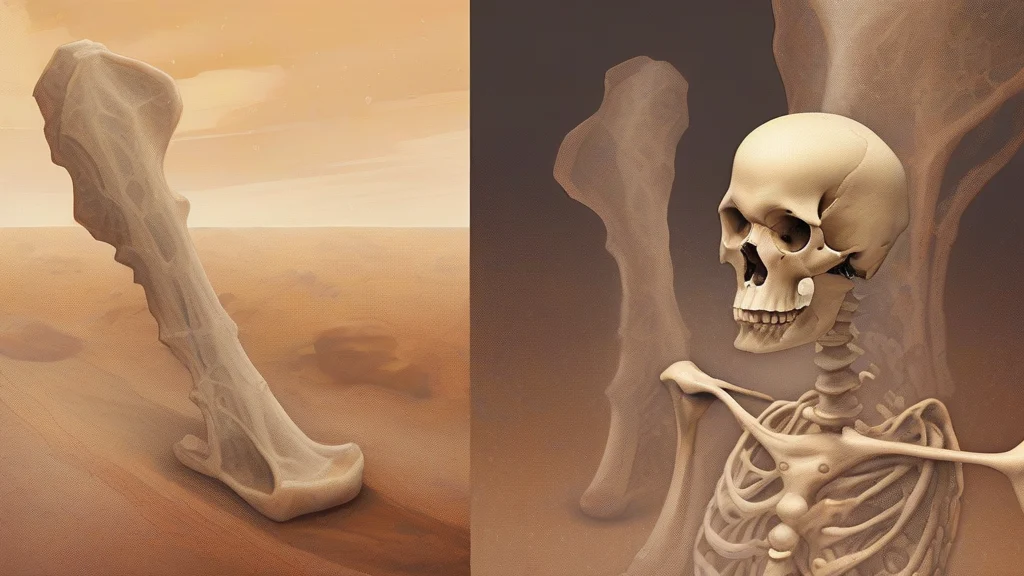
What does osteoid mean?
Osteoid is the unmineralized, collagen-rich matrix from which bone develops. It forms before calcium and other minerals are deposited, so it can be understood as bone’s organic framework or blueprint. In histology, osteoid appears as pale, relatively soft material around developing bone trabeculae, and its abundance and arrangement can help pathologists assess bone formation and certain bone disorders. The term is also important in tumor pathology: an osteoid osteoma is a benign, painful bone-forming tumor in which osteoid makes up much of the lesion. Although the word is principally a technical medical term, it accurately distinguishes new bone tissue before mineralization from fully formed mineralized bone. Its etymology likewise reflects its role, combining a form meaning “bone” with a suffix meaning “resembling” or “like.”
nounThe unmineralized organic matrix of bone, composed mainly of type I collagen. In the compound “osteoid osteoma,” the term also refers to the bone-forming tissue that makes up the lesion.
- The unmineralized organic matrix from which bone tissue is formed.
- In medical terminology, the predominantly unmineralized tissue constituting a bone-forming lesion, especially an osteoid osteoma.
"Microscopic examination showed abundant osteoid surrounding the newly formed bone trabeculae."
"The biopsy revealed irregular seams of osteoid between the mineralized bone trabeculae."
"An osteoid osteoma is a benign bone-forming tumor that typically causes localized pain."
Usually uncountable when referring generally to unmineralized bone matrix; pluralized when referring to distinct deposits or lesions.
"The imaging findings were consistent with multiple osteoids in the affected bone."
Osteoid is bone’s blueprint—the collagen framework that minerals later harden into a load-bearing structure.
Reviewed by Deb Chak, Editor. AI-assisted content curated by RJS Tech Solutions LLP.
Etymology of osteoid
Osteoid was formed from Greek osteon, meaning “bone,” together with the combining form -oid, derived from Greek eidos, meaning “form” or “resemblance.” The resulting name literally conveys “bone-like” material and was applied to the organic matrix of bone. The Greek element osteon also underlies related medical terms such as osteoblast, osteoclast, osteology, and osteoporosis.
How osteoid is actually used
In histology and pathology, “osteoid” is technical vocabulary for unmineralized bone matrix. It is normally uncountable when referring to the tissue, while plural usage can refer to distinct deposits or lesions. The compound “osteoid osteoma” is the established name of a particular benign bone tumor.