
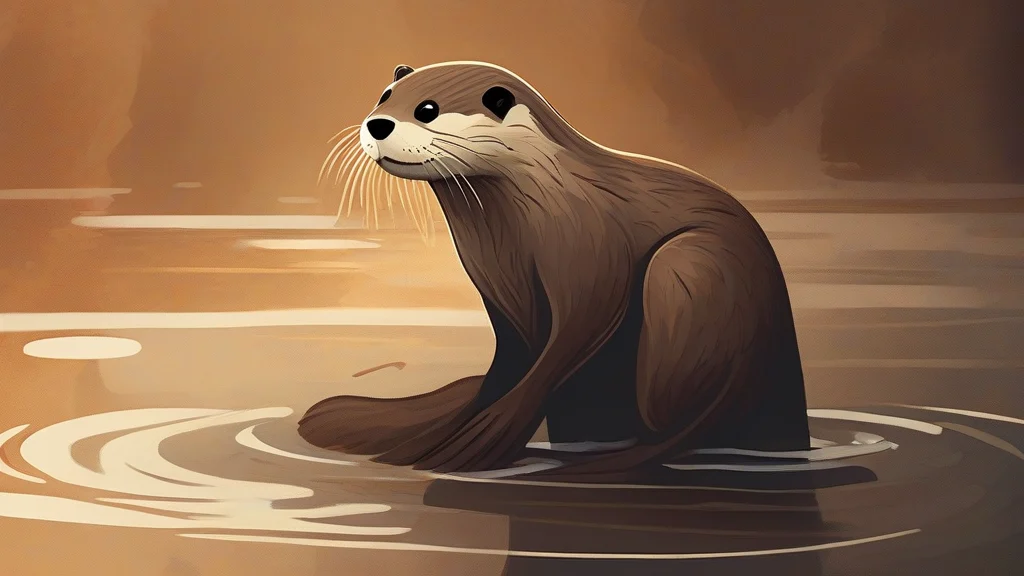
What does otter mean?
Otter most commonly names a semiaquatic mammal in the weasel family. River otters live along freshwater rivers, lakes, and wetlands in many parts of Europe, Asia, and North America, while the sea otter is a distinct marine species of the Pacific coast. Otters are intelligent, agile animals with dense fur, webbed feet, and a long, muscular body. They are often portrayed as playful, although their diet consists mainly of fish, crustaceans, and other aquatic animals. The word can also refer to an otter's fur, particularly in historical descriptions of clothing. Much less commonly, otter is a verb meaning to hunt for or take otters, a use now largely confined to older or literary contexts. In contemporary writing, the noun usually carries friendly and conservation-related associations, especially when describing wildlife habitats, protected species, or encounters with otters in rivers and along coasts.
Any of various aquatic or semiaquatic carnivorous mammals of the weasel family, including river and sea otters; also the fur of such an animal.
"An otter emerged from the river carrying a fish between its paws."
River otter and sea otter are distinct species, although both belong to the weasel family.
To hunt for or take otters.
"The licence permitted him to otter the river and sell the skins."
This sense is now rare and is chiefly historical or literary.
The plural takes a plural verb when referring to several individual animals.
"A group of otters was travelling together along the riverbank."
Sea otters may float together in rafts, using kelp and one another to keep from drifting apart while they sleep.
Reviewed by Deb Chak, Editor. AI-assisted content curated by RJS Tech Solutions LLP.
Where does otter come from?
The English word descends from Old English otter, which was inherited from Proto-Germanic *uttraz. It is cognate with forms such as Old Norse otr, Danish oter, and Icelandic otur. In Middle English, otter continued to denote the familiar river-dwelling animal and was also used for its valuable fur.
How otter is actually used
The noun is standard in British and American English. The verb is rare and chiefly historical or literary. British English typically has /ˈɒtə(r)/, while the usual American pronunciation is /ˈɑːtər/.