
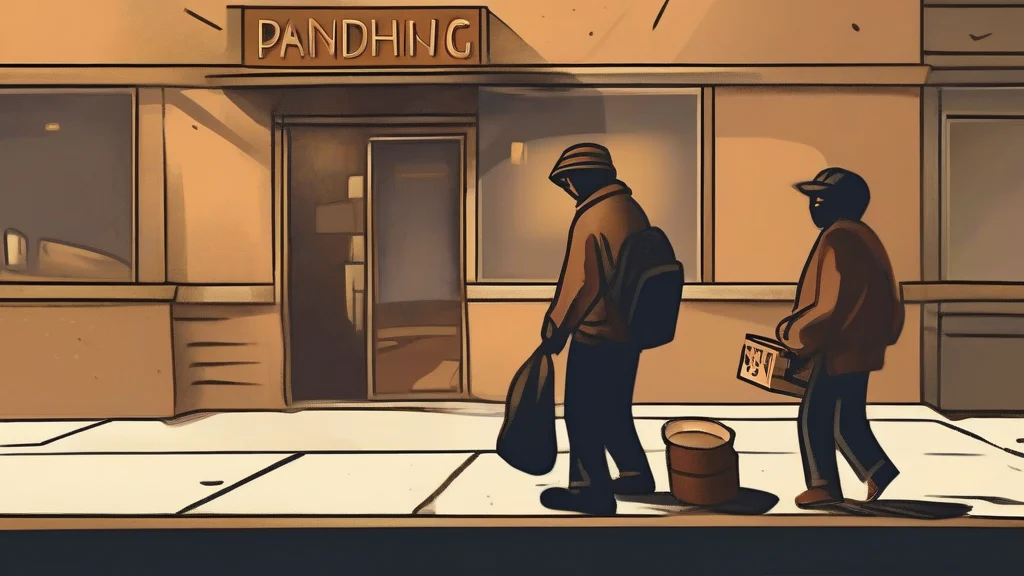
What does panhandling mean?
Panhandling is the practice of begging for money, food, or other assistance in a public place, especially from people passing along a street or near a transport station. The term can be used neutrally to describe the activity, but it is also common in news and public debate about city regulations, social services, and the treatment of people who rely on alms. Panhandling differs from busking, which usually involves a performance, and from sponging, which often describes asking friends or acquaintances for help. A related noun, panhandler, refers to a person who begs, while the verb panhandle describes the act itself. The compound formed from pan and handle reflects an older practice in which a person used a pan to collect coins or other small contributions.
nounThe act of begging for money or food in a public place, typically from passers-by. It can also refer more broadly to persistent or aggressive solicitation of alms.
- Begging for money or food in a public place.
- More broadly, persistent or aggressive solicitation of alms.
"The city council debated stricter rules targeting panhandling near the transit station."
"Several complaints about panhandling were reported near the station entrance."
"Volunteers developed a program to help people involved in panhandling find support services."
The plural is uncommon; discussion more often uses the uncountable singular form.
"The report documented several panhandlings outside the train station."
Panhandling is a word made from two ordinary words: to pan for something and to handle it—coined for people who sought money by handling a pan and soliciting contributions.
Reviewed by Deb Chak, Editor. AI-assisted content curated by RJS Tech Solutions LLP.
Where does panhandling come from?
The word panhandling developed in the early 19th century in the United States. Its verb, panhandle, was formed from pan and handle, apparently referring to using a pan or similar receptacle to collect money or gifts. The related noun panhandler followed from the same compound. Although the expression is especially associated with North American English, the compound's literal imagery—handling a pan to gather contributions—also appears in older descriptions of street begging.
Related word forms
How panhandling is actually used
The term is often used in legal, civic, and social-policy contexts. It may sound more formal or bureaucratic than the plainer phrase “begging in the street,” and some speakers use it to distinguish public solicitation from private requests for assistance.
Easily confused with panhandling
Panhandling usually means asking passers-by for money directly, whereas busking generally means performing music or other entertainment in exchange for donations.
Panhandling specifically involves begging in public, while sponging can mean repeatedly asking friends, relatives, or acquaintances for money or favors.