
What does pegasus mean?
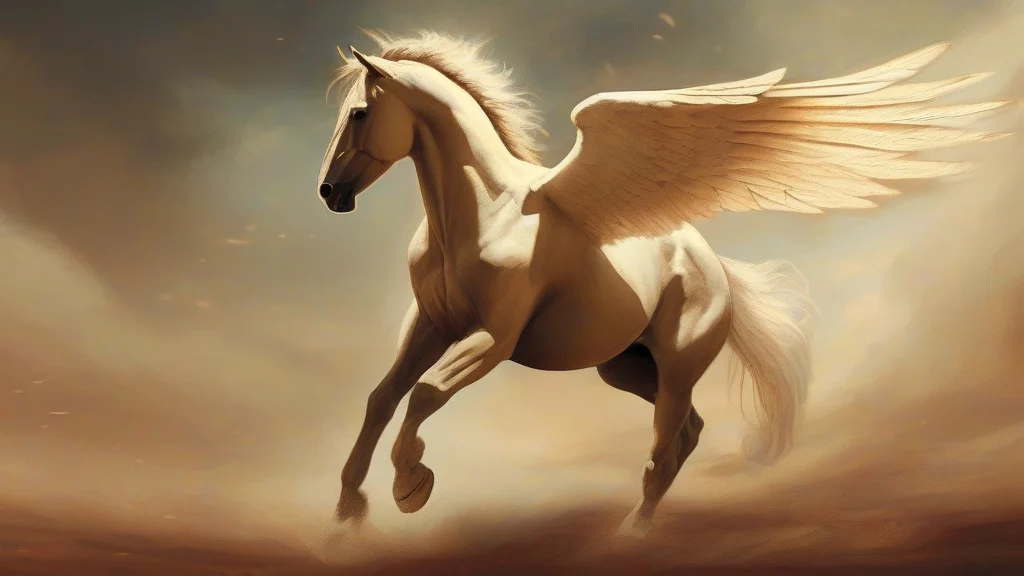
A pegasus is a winged horse from Greek mythology. In the best-known legend, Bellerophon rides the creature to kill the Chimera, although the horse later becomes associated with the sky and immortality. The name also denotes the northern constellation containing the Great Square, four relatively bright stars arranged in a distinctive quadrilateral. Because Pegasus is the emblematic flying horse of ancient legend, writers may use the term figuratively for a horse of exceptional speed or for something that rises above ordinary limitations. The word is mainly encountered in discussions of mythology, astronomy, and literature. Ordinary speakers are more likely to recognize the constellation's name than to use the word independently, and the mythological name is normally treated as a proper noun.
nounA winged horse in Greek mythology, ridden by Bellerophon. The name also refers to the northern constellation containing the bright star called the Great Square.
- The winged horse of Greek mythology, traditionally ridden by Bellerophon.
- The northern constellation containing the Great Square, also known as the Square of Pegasus.
- Literally, a swift or airborne horse used in extended poetic or figurative comparisons.
"The artist depicted the winged horse pegasus soaring above the clouds."
"Bellerophon captured the golden bridle and rode pegasus toward the monstrous Chimera."
"The stars of the Pegasus constellation are visible in the northern autumn sky."
The plural is used when referring to more than one mythological winged horse. The name of the constellation is normally treated as a singular proper noun.
"Ancient artists often depicted the two pegasi as twin winged horses."
Pegasus gives its name to both a mythological flying horse and the northern sky's great square of four stars.
Reviewed by Deb Chak, Editor. AI-assisted content curated by RJS Tech Solutions LLP.
Where does pegasus come from?
The word comes through Latin from the Greek name Pēgasos for the mythological winged horse. Greek tradition associated Pegasus with Bellerophon and with the spring that opened when the horse struck the ground with his hoof. The same name was subsequently applied to the northern constellation, preserving the association between the horse and the heavens.
How pegasus is actually used
As the mythological creature, the name is usually capitalized in modern English, although historical and literary usage can vary. As the constellation, it is always capitalized. The figurative use is literary and comparatively uncommon.