
What does pelvis mean?
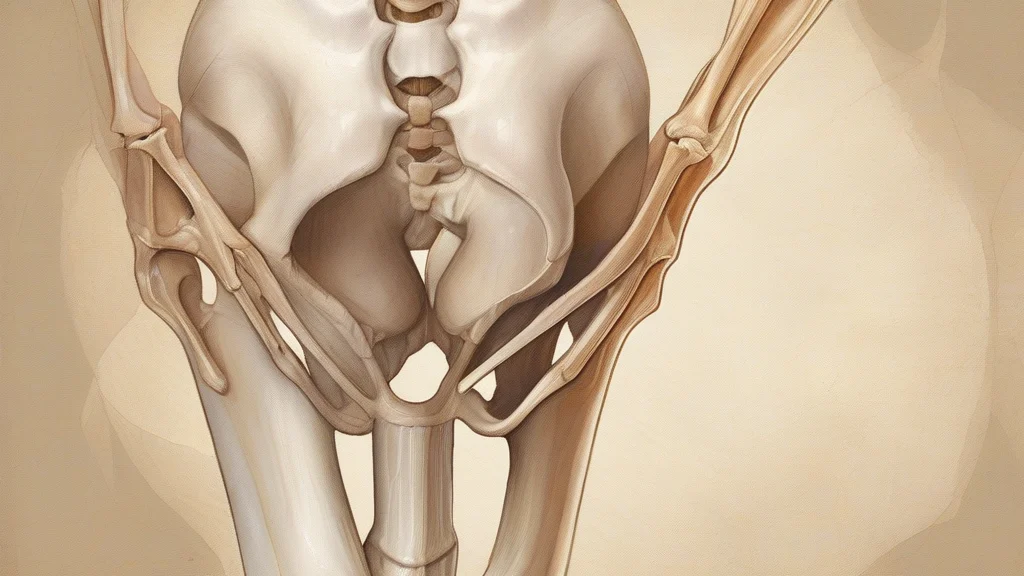
The pelvis is the basin-shaped bony structure at the base of the spine, formed by the hip bones, sacrum, and coccyx. It supports and stabilizes the trunk, transfers the upper body's weight to the lower limbs, and provides attachment points for the muscles that move the hips and legs. In medical and anatomical usage, “pelvis” may refer either to the complete bony framework or to the internal region containing the bladder, reproductive organs, and rectum. The term is also used in expressions such as “pelvic floor,” “pelvic bones,” and “pelvic girdle.” Although the word may sound formal or clinical, it is the standard anatomical name for this central part of the skeleton, and understanding the pelvis helps explain how the body supports itself while protecting several essential organs.
nounThe basin-shaped structure of bones at the base of the spine that supports the upper body and connects the spine to the lower limbs. It encloses and protects parts of the lower abdomen and pelvis, including the bladder, reproductive organs, and rectum.
- The bony basin at the base of the spine, formed by the two hip bones, the sacrum, and the coccyx.
- The internal cavity and structures contained within this bony basin, especially the lower abdominal and pelvic organs.
"The scan revealed a small fracture in her pelvis."
"The athlete recovered fully after a serious pelvis injury."
"The doctor explained that infection in the pelvis can become severe without prompt treatment."
The standard plural is pelves, although the singular form pelvis is also used attributively, as in pelvis fracture.
"The surgeon examined the patient’s pelves after the accident."
The pelvis is the body's load-bearing crossroads, transferring the weight of the upper body to the legs while also protecting vital pelvic organs.
Reviewed by Deb Chak, Editor. AI-assisted content curated by RJS Tech Solutions LLP.
Where does pelvis come from?
The word comes through Old French from Latin pelvis, meaning “a basin,” a meaning that reflects the pelvis's bowl-like shape. Latin also used the word in related anatomical senses. It underlies English derivatives such as pelvic, pelvimetry, and pelviplasty, and cognate forms occur in several other European languages.
Related word forms
How pelvis is actually used
In medical and anatomical contexts, the term is commonly used for both the bony structure and the internal region it encloses. It is not typically used in ordinary conversation to refer to the whole hip area.
Easily confused with pelvis
The pubis is the front portion of the hip bone, whereas the pelvis is the complete basin-shaped structure formed by the hip bones and the sacrum.