
What does permafrost mean?
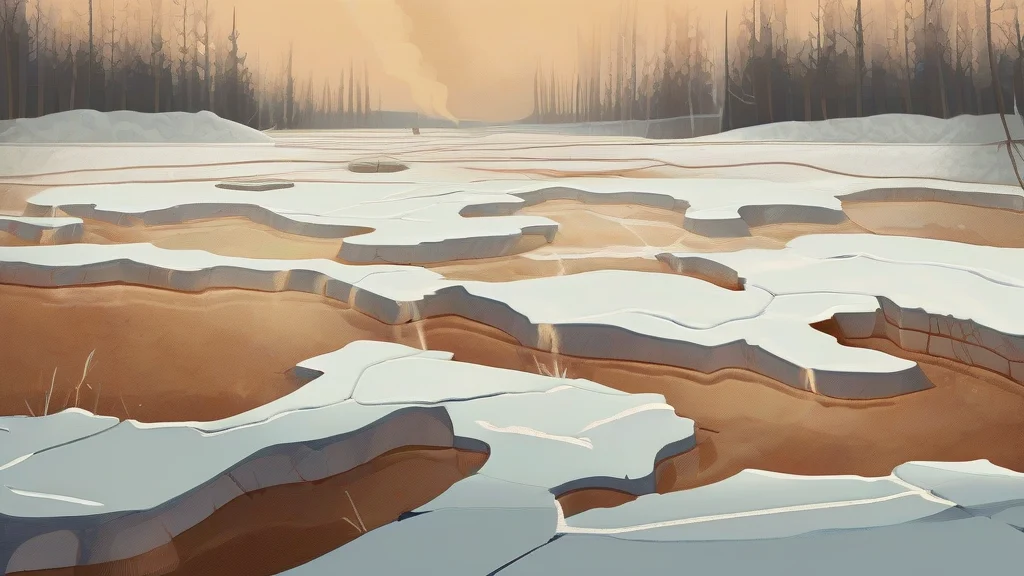
Permafrost is ground that remains at or below freezing throughout the year for at least two consecutive years. It occurs widely in Arctic and subpolar environments and may consist of soil or rock that is ice-rich or dry. The term is important in climatology because warming temperatures can thaw it, potentially releasing carbon dioxide and methane and destabilizing ecosystems, infrastructure, and communities. Permafrost also preserves fragments of plants, animals, and atmospheric material, making it valuable for reconstructing past climates. In everyday discussion, the word often refers specifically to the northern permafrost of the Arctic, although permafrost also occurs at high elevations and in Antarctic and mountainous environments. Its association with thawing has made it a prominent term in conversations about climate change, while its scientific sense remains more specific than the general expression “frozen ground.”
nounPermanently frozen ground, especially in polar and subpolar regions, that remains at or below 0°C for at least two consecutive years. It may consist of soil or rock and can be ice-rich or dry; persistent subzero temperature is its defining feature.
- Permanently frozen ground, especially in polar and subpolar regions, that remains at or below 0°C for at least two consecutive years.
"As summers lengthen, engineers must design roads and buildings for ground that is thawing beneath permafrost."
"As summers lengthen, engineers must design roads and buildings for ground that is thawing beneath permafrost."
"The expedition drilled through hundreds of metres of permafrost to study ancient environmental records."
The plural is uncommon; permafrost is normally treated as a mass noun, but it can be pluralized when referring to separate frozen-ground bodies.
"Researchers compared the permafrosts beneath two Arctic settlements."
As Arctic temperatures rise, thawing permafrost can release carbon dioxide and methane into the atmosphere.
Reviewed by Deb Chak, Editor. AI-assisted content curated by RJS Tech Solutions LLP.
Etymology of permafrost
The word was formed in English in the early 20th century from permanent and frost, shortening the earlier phrase “permanent frost.” Permanent ultimately comes from Latin permanere, “to remain, persist,” formed from per-, meaning “through,” and manere, “to remain.” Related English words include permanent, permanence, and the informal shortening perm.
How permafrost is actually used
This is chiefly a technical term in geography, climate science, ecology, engineering, and archaeology, although it is now familiar in general discussion of Arctic change. It usually functions as a mass noun, but plural forms are possible when referring to distinct frozen-ground bodies.
Easily confused with permafrost
Frost is ice or a thin frozen layer formed on surfaces, whereas permafrost is ground that remains frozen at or below 0°C for at least two consecutive years.
Seasonal frost thaws during warmer months, while permafrost persists through seasonal temperature changes.