
What does phalanx mean?
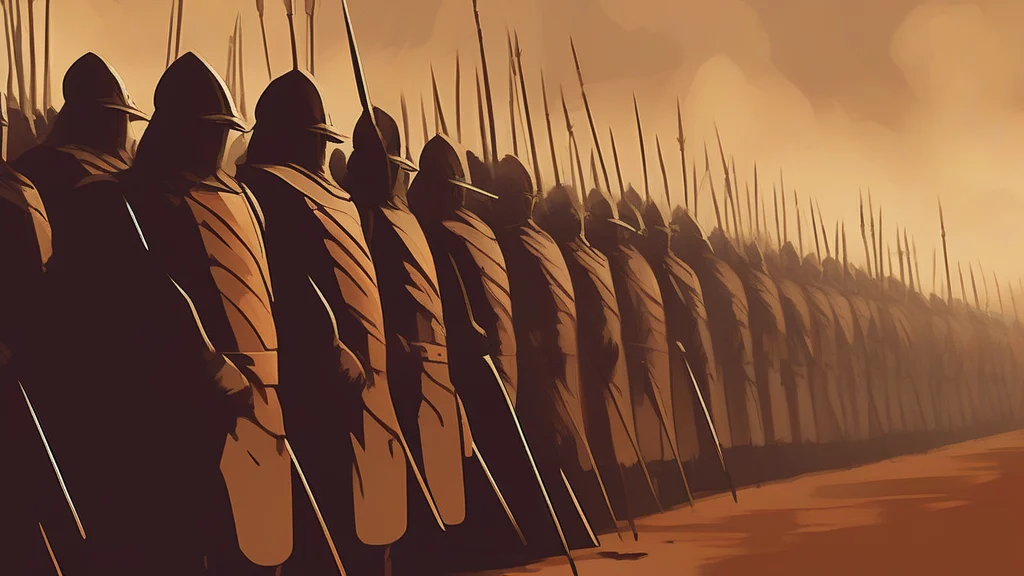
A phalanx is an ancient military formation in which soldiers stood in close, ordered ranks, usually with their shields overlapping to create a protective wall. The best-known examples were used by Greek and Macedonian armies, including the powerful formation associated with Alexander the Great. The word also has a figurative meaning: a phalanx can describe a tightly knit body of people united by a shared purpose, political interest, or allegiance. In this use, it often emphasizes organization and collective strength, though it can suggest rigidity or an excessively unified front. The word is most common in historical writing, discussions of ancient warfare, and figurative descriptions of political or social blocs. Its distinctive imagery is of many individuals forming a single, coordinated structure.
nounA military formation in which soldiers stand close together in rows with shields overlapping, especially one of the formations used by ancient Greek and Macedonian armies. By extension, the word can mean a tightly organized group of people united by a shared purpose or interest.
- An ancient military formation of soldiers arranged in closely packed, mutually supporting rows.
- A large, tightly organized group of people sharing a common interest, purpose, or allegiance.
- A solid, coordinated body or arrangement of things.
"The phalanx advanced slowly across the battlefield, its overlapping shields forming a solid wall."
"The Macedonian phalanx was famous for its long spears and disciplined formation."
"The committee formed a phalanx of opposition to the proposed policy."
The standard plural is phalanges; phalanxes is also used in some contexts, especially for distinct military formations.
"Several phalanges marched through the narrow pass."
From the Greek word for a line of battle, the phalanx became one of history’s most recognizable military formations—and later a metaphor for any powerful, unified bloc.
Reviewed by Deb Chak, Editor. AI-assisted content curated by RJS Tech Solutions LLP.
Where does phalanx come from?
The word comes through Latin from Greek phalanx, meaning a line or formation of soldiers, originally a row of men joined by overlapping shields. The Greek term derives from phalangein, “to form a line,” associated with phalanx, a line or log of wood and ultimately a line of battle. The same Greek root also underlies the anatomical family represented by phalange and phalangeal, referring to the bones of the fingers and toes.
Related word forms
How phalanx is actually used
The military sense is historical and chiefly refers to the ancient Greek and Macedonian formations. The extended sense, meaning a cohesive political or social group, is figurative and often carries a suggestion of strength, unity, or rigidity.
Easily confused with phalanx
A phalanx is a military formation or a closely united group; a phalanx in anatomy is not a standard term, whereas the related phalanges are the bones of the fingers or toes.