
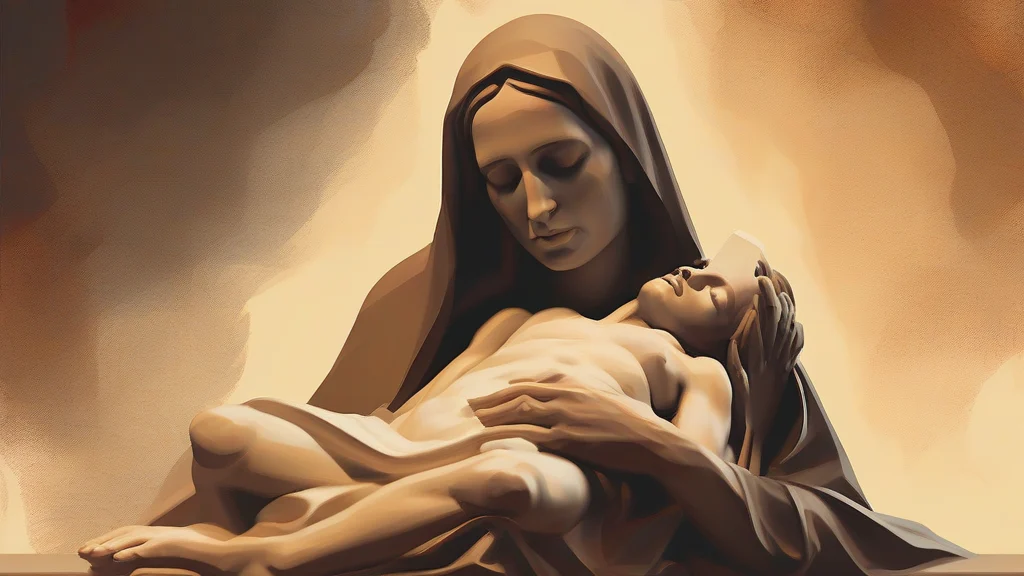
What does pieta mean?
A pietà is an artistic representation, most often a sculpture, of the Virgin Mary holding or mourning the dead body of Christ. The image draws on the Gospel accounts of Christ's crucifixion and burial, especially the grief of Mary as his mother. In art history, the term is especially associated with Renaissance sculpture, including Michelangelo's celebrated Pietà in St Peter's Basilica in Vatican City. The word can also be used more broadly for a work that evokes profound sorrow or compassion. Its modern English form comes from Italian, where it means pity or compassion. Although the subject is intensely tragic, the finest pietàs often convey solemnity, tenderness, and serenity rather than uncontrolled anguish. The term should not be confused with piety, which concerns religious devotion, or pita, the flatbread.
nounA representation, especially a sculpture, of the dead Christ held or mourned by the Virgin Mary. The term may also refer more broadly to a work of art expressing grief, sorrow, or compassion.
- A representation, especially a sculpture, of the dead Christ held or mourned by the Virgin Mary.
- A work of art expressing grief or compassion.
"The quiet chapel contains a marble pietà illuminated by soft light from a high window."
"Visitors gathered before the pietà, studying the sculptor's treatment of Mary's grief."
"Her expression in the painting conveys the sorrow associated with a pietà."
Used when referring to multiple separate works or representations of this kind.
"The collection includes pietas carved by artists working in several European countries."
Before printing one word, Michelangelo carved the Pietà: a mother holding her murdered son, yet composed with astonishing calm.
Reviewed by Deb Chak, Editor. AI-assisted content curated by RJS Tech Solutions LLP.
Where does pieta come from?
The English word comes from Italian pietà, meaning pity or compassion, in which it names a representation of Mary mourning the dead Christ. Italian pietà was borrowed from Latin pietas, meaning pity, compassion, or dutifulness, a noun associated with pius, “dutiful” or “pious.” Related English words such as pity, piety, and impiety belong to this same Latin family.
How pieta is actually used
The common name is normally written with one initial capital and no accent in English: pieta. When referring to a particular titled artwork, especially Michelangelo's famous sculpture, the Italian spelling Pietà is customary. The definite article “La” is usually omitted in English.
Easily confused with pieta
Piety means reverent devotion to God or religious practice, whereas a pietà is an artistic representation of Mary mourning the dead Christ.
A pita is a flatbread, while a pietà is a religious sculpture or artwork.