
What does pimple mean?
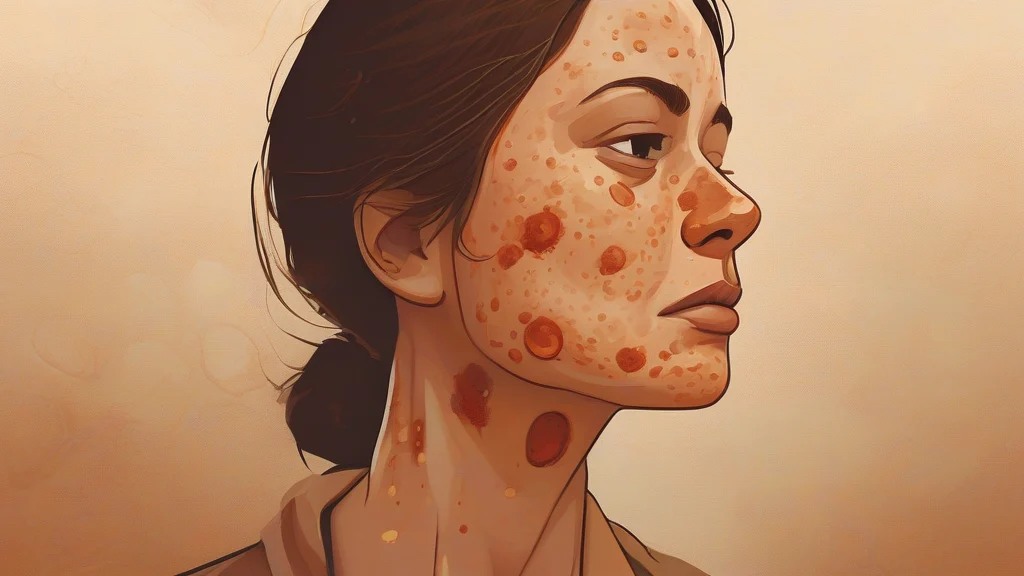
A pimple is a small raised spot on the skin, often caused by a blocked pore, acne, or inflammation around a hair follicle. It can be red, tender, or contain pus, and the word is commonly used in everyday speech in both British and American English. Figuratively, a pimple can mean a minor, short-lived problem, especially in phrases describing a political or organizational difficulty as trivial. The term is broader and less technical than words such as papule, which refers to a solid raised lesion, or pustule, which specifically contains pus. In general writing, pimple is natural but informal; medical and dermatological contexts generally favor more precise terminology. Its long history, preserved through Old French and Latin, makes this familiar skin complaint an unexpectedly well-traveled word.
A small raised spot or swelling on the skin, especially one associated with a blocked pore, acne, or an inflamed hair follicle.
"The treatment reduced the pimple on her forehead."
Common in informal and everyday usage; medical contexts may use more precise terms such as papule or pustule.
To form pimples or become covered with pimples.
"His skin began to pimple during the heat wave."
Less common than the noun and usually informal.
The usual plural of pimple.
"The cream is intended to dry up pimples."
A pimple may be tiny, but its name has an unexpectedly long history: it comes through Old French from Latin, where the related word papula referred to a small swelling of the skin.
Reviewed by Deb Chak, Editor. AI-assisted content curated by RJS Tech Solutions LLP.
Where does pimple come from?
Pimple developed in Middle English from Old French pimple, a word referring to a small pimple or swelling. This was borrowed from Latin papula, meaning a pimple or pustule, which is related to papilla, the nipple or nipple-like projection. The English word has also been influenced by the pattern of diminutive formation, leading to the related adjective pimply and the form pimpled.
Related word forms
How pimple is actually used
Usually informal or everyday in both British and American English. In medical contexts, related terms such as papule and pustule are more precise; a pimple is not necessarily filled with pus.
Easily confused with pimple
A pimple is generally a small superficial spot, while a boil is a larger, deeper inflamed lump that can involve a hair follicle.
A pimple is often temporary and inflamed, whereas a wart is a persistent, usually painless growth caused by a virus.