
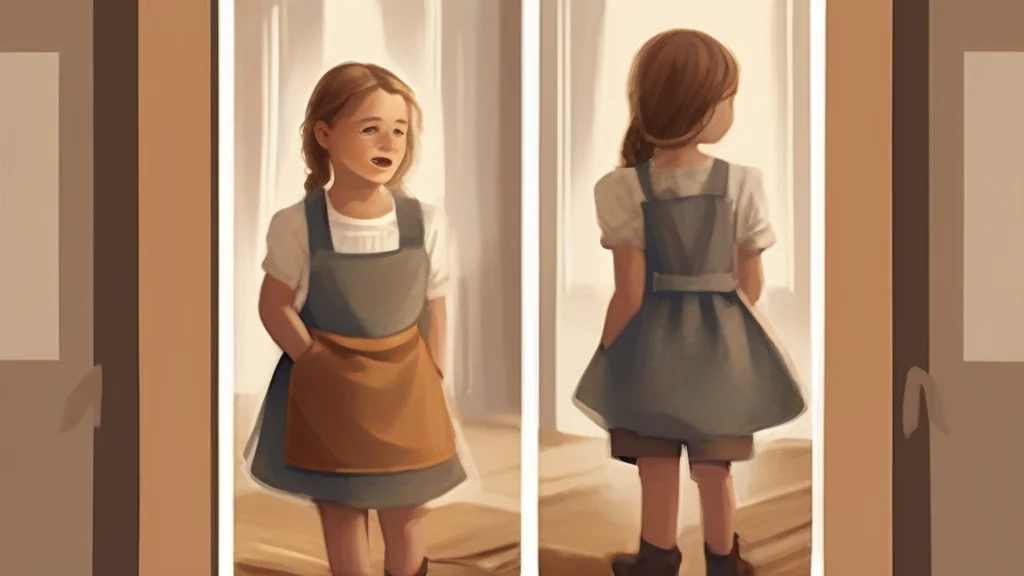
What does pinafore mean?
A pinafore is a sleeveless apron-like garment traditionally worn over the front of the body. It may be fastened at the neck and extend down to the knees or lower, and it is commonly associated with children’s schoolwear, domestic work, and traditional clothing. In another established use, “pinafore” refers to a simple sleeveless dress with an apron-like front, especially a style worn by young girls. The word can sound old-fashioned today, but it remains useful because it identifies a specific garment rather than any general apron or overall. Its combination of everyday clothing and historical associations gives it a distinctive, slightly nostalgic character, making it especially evocative in descriptions of period settings, schools, and household routines.
A sleeveless apron worn over the front of a dress or garment, traditionally by children or domestic workers.
"She wore a pinafore while serving breakfast."
This is the most common modern sense, though the term often has a traditional or old-fashioned tone.
A simple sleeveless dress with an apron-like front, traditionally worn by children.
"The school photograph shows the pupils in white pinafores."
This sense is especially associated with children’s clothing and historical or traditional dress.
The standard plural adds “-s” and is used when referring to multiple garments or dresses.
"Several brightly colored pinafores hung in the cloakroom."
The name pinafore literally means a garment pinned or fastened in front, a description that makes its distinctive shape instantly memorable.
Reviewed by Deb Chak, Editor. AI-assisted content curated by RJS Tech Solutions LLP.
Where does pinafore come from?
The word is formed from “pin” and “afore,” an older word meaning “in front of.” It was recorded in the 19th century for a garment pinned or fastened in front, reflecting the garment’s shape and fastening. “Afore” itself comes from an Old English formulation meaning “before,” while the related “fore-” element survives in modern words such as “before” and “forehead.”
How pinafore is actually used
The word is somewhat old-fashioned and formal in modern English, though it remains common in descriptions of school clothing and traditional dress. It is more familiar in British English but is also used in American English.
Easily confused with pinafore
An apron is a general protective garment worn over clothing, whereas a pinafore is specifically a sleeveless garment fastened at the neck and often extending down the front.