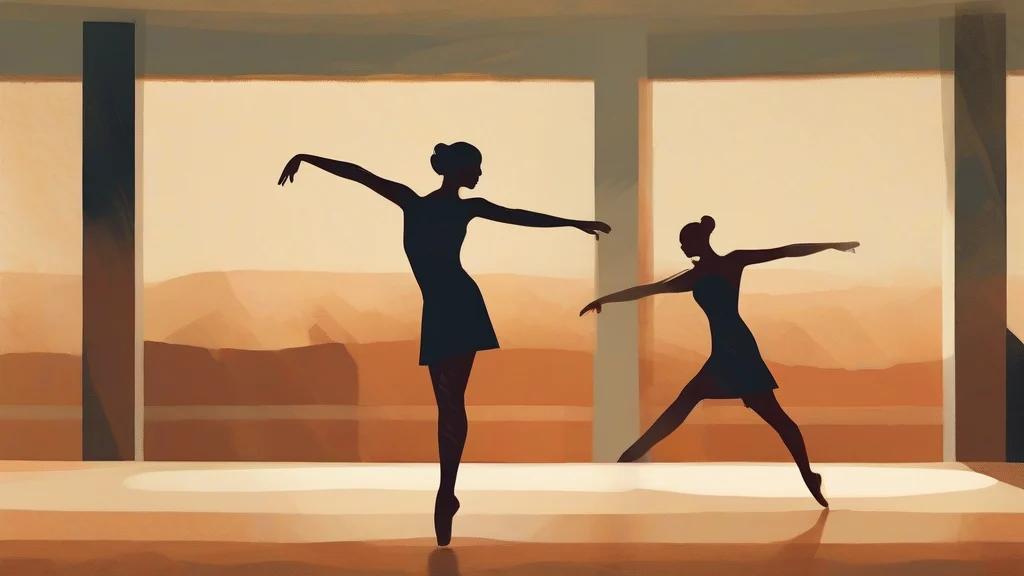
What does pirouetting mean?
Pirouetting refers to the act of rapidly turning or spinning around, typically on one leg, often as part of a dance or exercise routine. This movement is commonly seen in ballet and figure skating, where it requires great balance, control, and technique. Pirouetting can be performed in various directions and at different speeds, and is often used to add dynamism and elegance to a performance. The term is derived from the French word 'pirouette,' meaning 'a whirling or spinning motion.' Pirouetting is a versatile movement that can be used in a variety of contexts, from classical dance to contemporary performances.
verbThe act of turning or spinning around rapidly, typically on one leg, in a circular motion, often as part of a dance or exercise routine.
- The act of performing a pirouette, a rapid turn on one leg.
- A spinning or whirling motion, often used in dance or exercise.
"The ballerina was pirouetting across the stage, her movements fluid and effortless."
"The dancer executed a flawless pirouette, her body a blur of motion."
"The figure skater's pirouette was impressive, earning her high scores from the judges."
Reviewed by Deb Chak, Editor. AI-assisted content curated by RJS Tech Solutions LLP.
Etymology of pirouetting
The term 'pirouetting' originates from the French word 'pirouette,' which refers to a whirling or spinning motion. The word 'pirouette' itself is derived from the Italian word 'pirueta,' meaning 'a turning or spinning motion.' The verb 'pirouetting' is used to describe the act of performing a pirouette, which involves rapidly turning or spinning around on one leg.
How pirouetting is actually used
Pirouetting is often used in the context of dance, particularly ballet, and can also refer to a spinning motion in other activities such as figure skating.